7 minutes
Entity Linking for SEO and AI Search: A Practical Guide
[TL;DR]
- Entity linking connects a mention of a specific thing, like a company or a product, to the one page that defines it.
- Its core job is disambiguation: removing any doubt about which real-world thing a mention refers to, so search engines and AI systems read it correctly.
- It works in two layers. Internal entity linking points a mention to your own topic page. External entity linking uses sameAs schema to tie that page to established entities in Wikidata, Wikipedia, or Google’s Knowledge Graph.
- Done across a site, entity linking builds a content knowledge graph, which is the same structure retrieval systems now use to find and ground AI answers.
What Is Entity Linking?
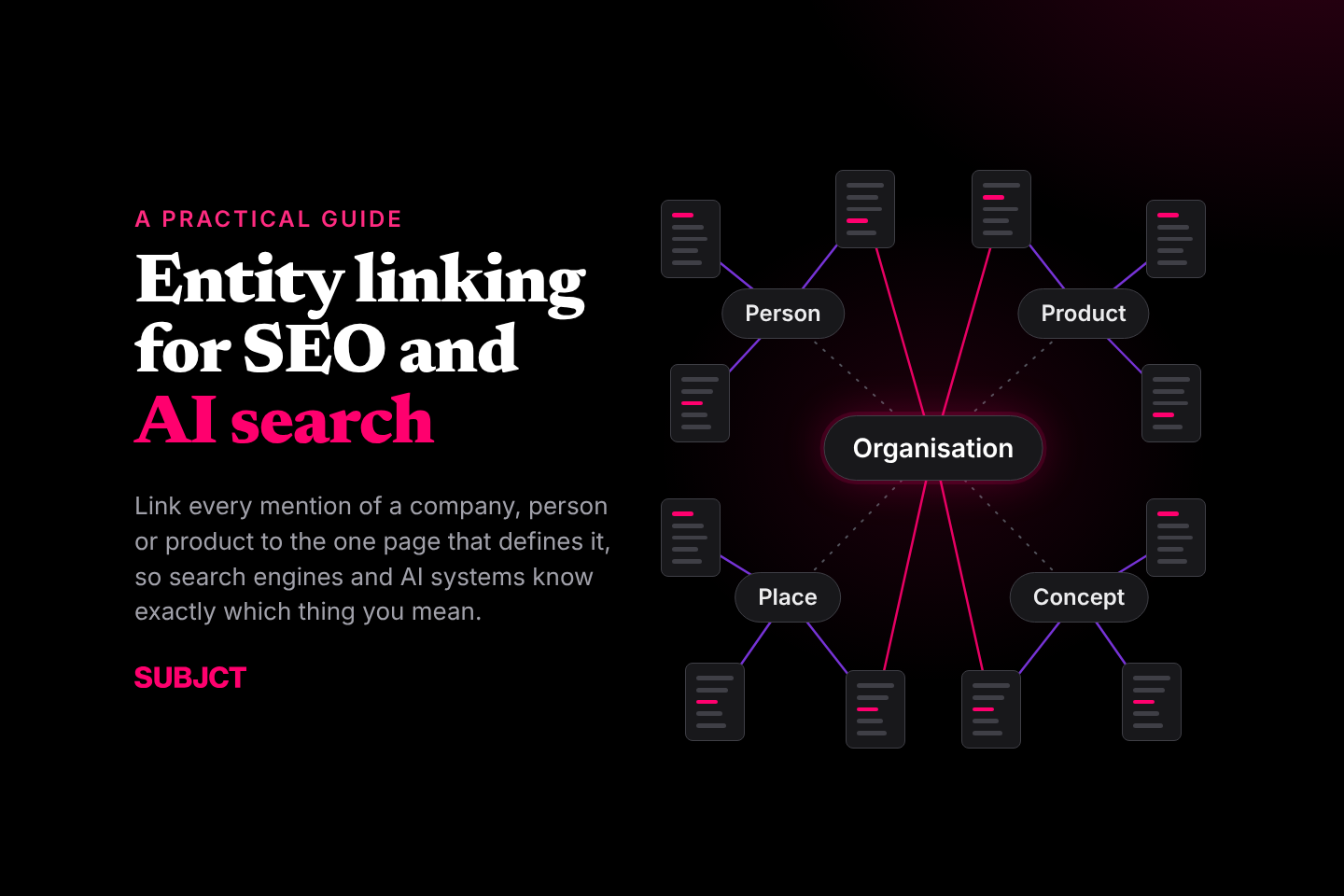
An entity is a distinct, identifiable thing – that could be a company, person, product, place, or concept.
Search engines and AI systems already organise information this way. Google's Knowledge Graph, for example, is essentially a database containing billions of facts about real-world entities.
Entity linking is the practice of connecting a mention of one of those entities to a single page that defines it. On your site, that means having one page that effectively “owns” an entity, then linking the first relevant mention of that entity back to it.
This is different from the internal linking most people already do. Ordinary internal linking connects one article to another, helping build topic clusters and move readers to the next useful piece. Entity linking connects a mention to its definition, routing references to the same thing back to the page that represents it.
In practice, the markup itself is nothing unusual. If “Amazon” is an entity with its own page on your site, the first mention might look like this:
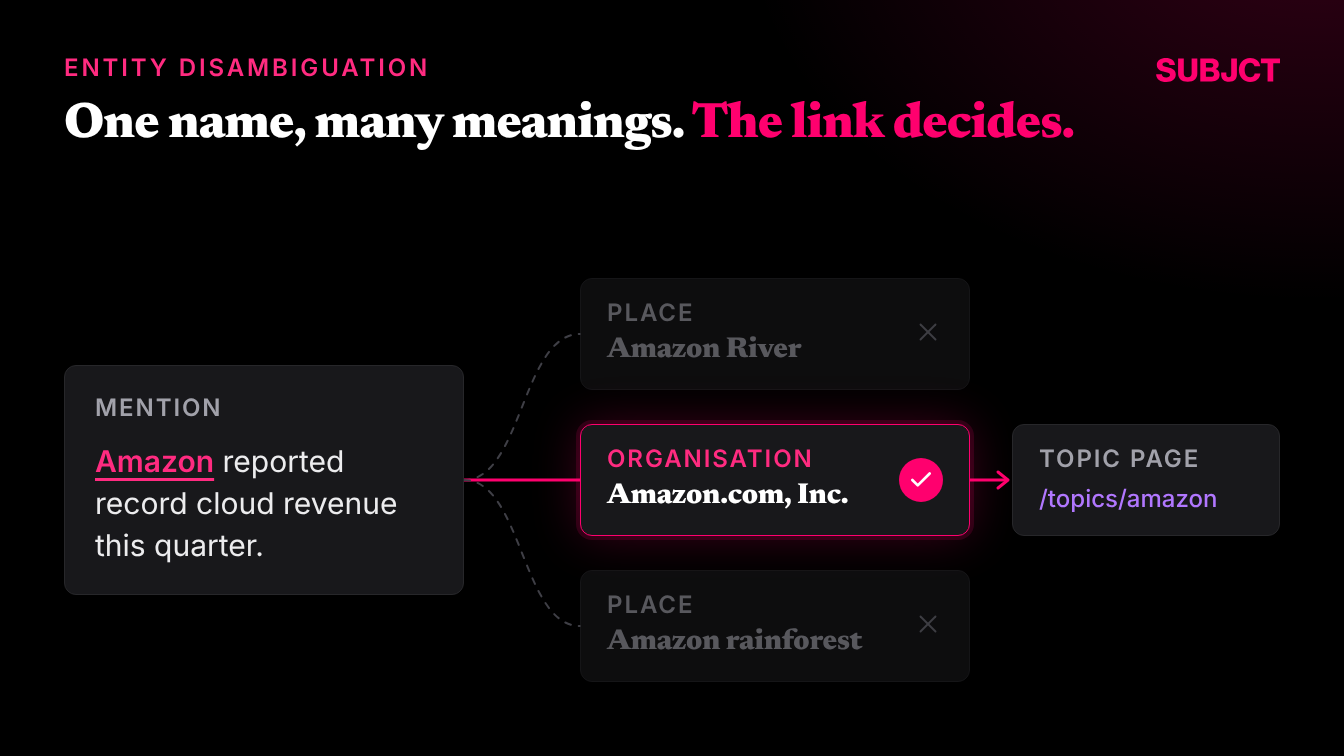
Here, “Amazon” is the anchor text, while /topics/amazon is the canonical page on your site for that entity. The link tells both readers and machines exactly which Amazon you mean.
The reason this matters is due to entity disambiguation. “Amazon” could refer to the technology company, the Amazon River, or the Amazon rainforest. A human can read the surrounding sentence and usually work out the intended meaning instantly.
A machine has to resolve that meaning using signals such as the surrounding context, structured data, and the links associated with the mention. Entity linking gives it another explicit signal by consistently connecting that mention to the page on your site that represents the entity.
Internal Entity Linking Versus External Entity Linking
Entity linking can be divided into two types: internal and external.
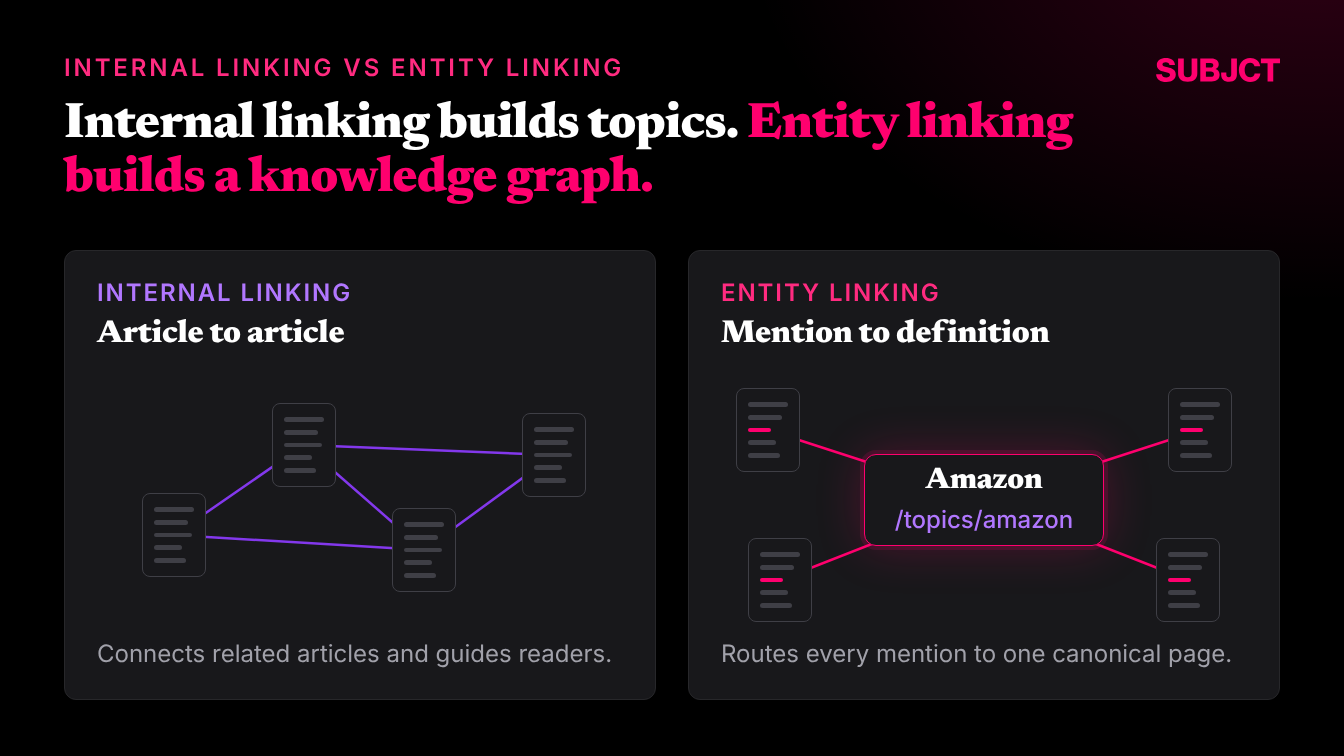
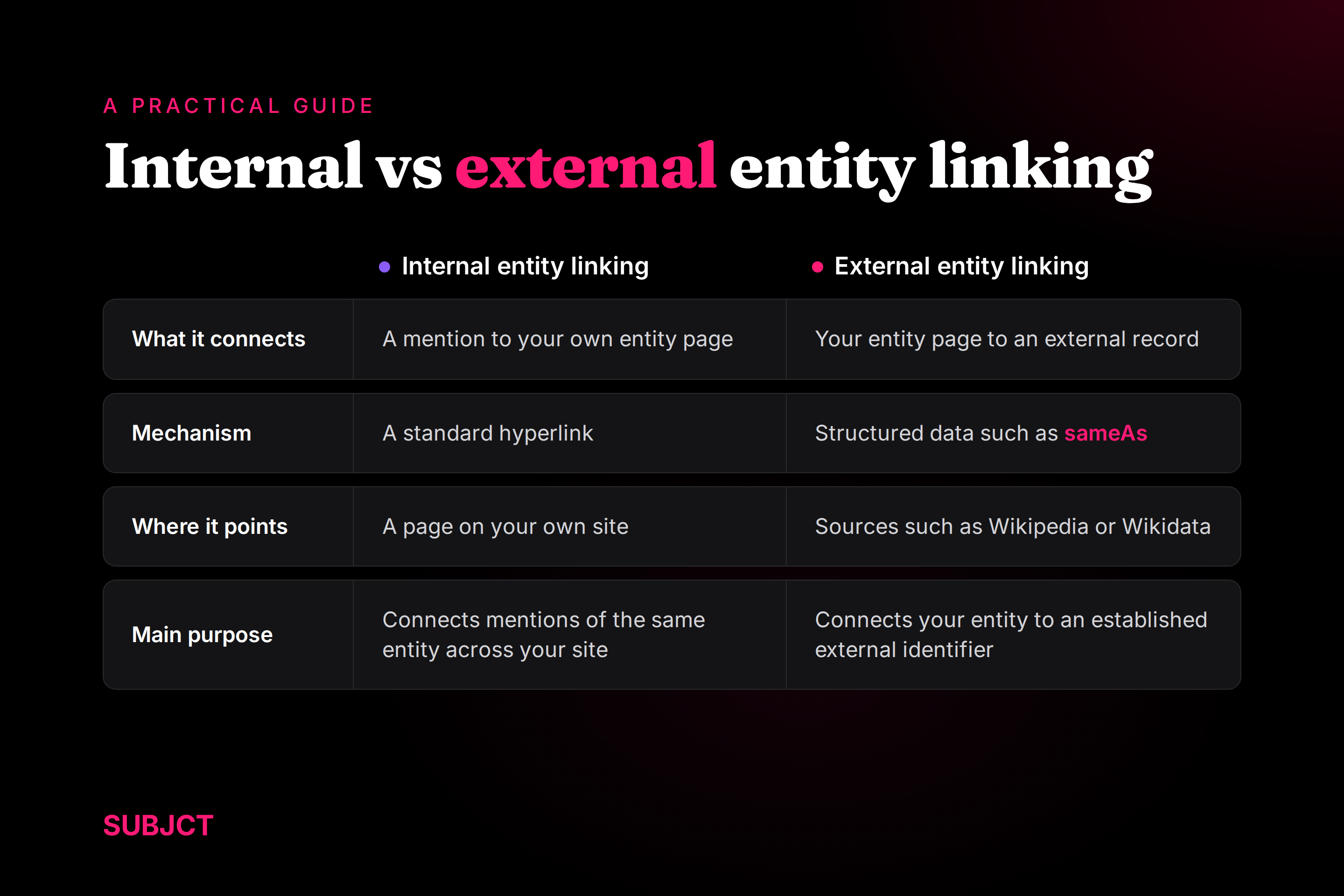
Internal entity linking is what we’ve already described, where mentions across your site point back to the page that represents that entity. External entity linking takes that a step further by connecting your entity page to an established record elsewhere on the web.
This external connection is usually made through schema markup, using properties such as sameAs. Rather than adding another visible hyperlink for readers, sameAs points machines to another URL that represents the same entity, such as its Wikipedia or Wikidata page, or a corresponding entity in Google’s Knowledge Graph.
For Amazon, that could look like this:
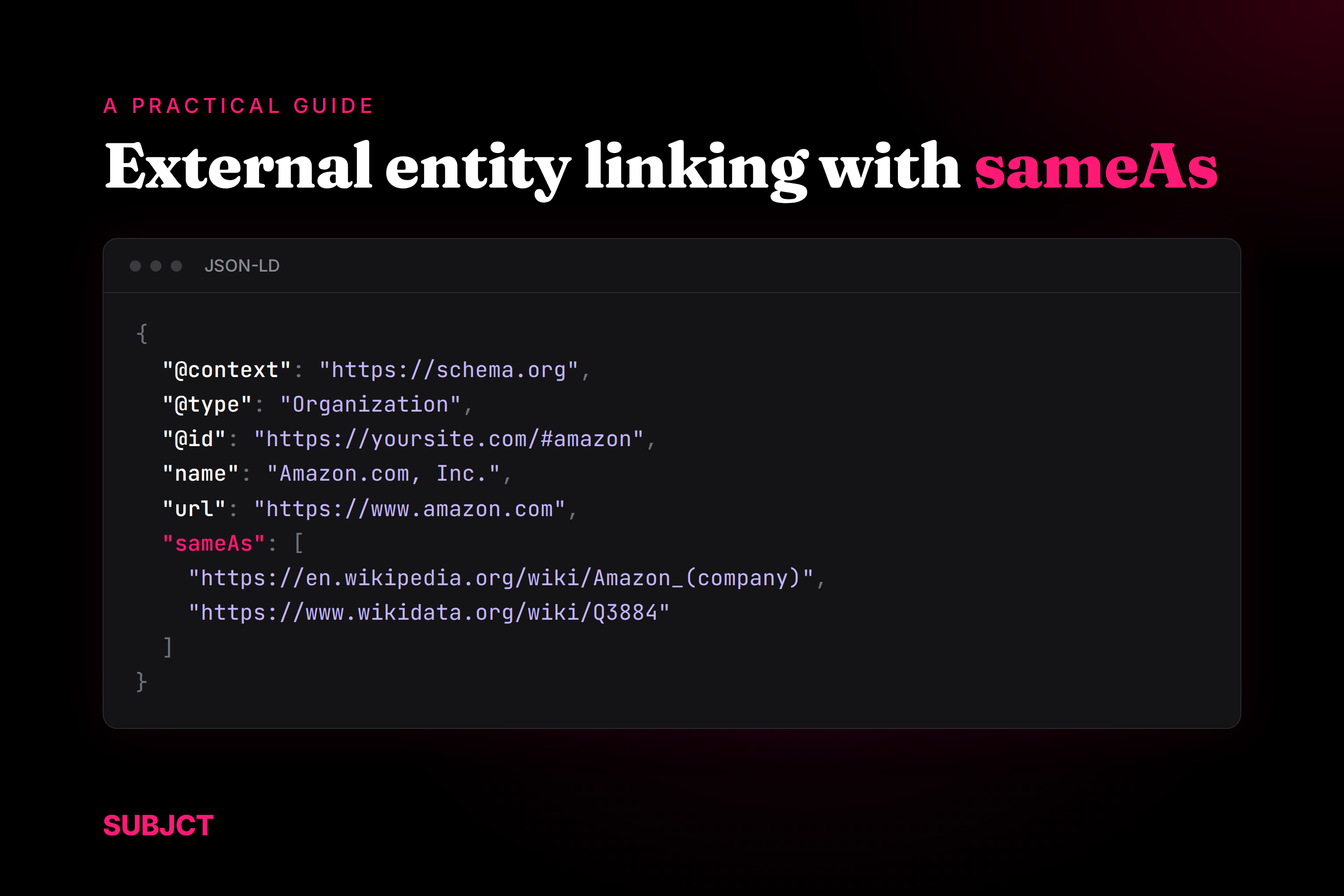
Here, the sameAs property connects the Amazon entity on your site to external records for the same company. Q3884, for example, is Amazon.com's Wikidata ID, which gives systems another explicit identifier for the entity.
Here are the major differences between internal and external entity linking:
Why Entity Linking Matters
These are the main benefits of entity linking:
1. It reduces ambiguity. A name can refer to different people, companies, places, or concepts. Linking a mention to the right page gives systems another signal to resolve the intended meaning, which matters for semantic relevance.
2. It concentrates internal signals. If the same entity appears across ten articles but none of those mentions connect to its central page, those references remain isolated. Linking relevant mentions back to one canonical page creates a consistent destination for that entity across the site.
3. It gives AI systems a clearer map of your content. When entities are linked consistently, systems can more easily identify which entities you cover, where their main pages live, and how they appear across different topics. That creates a much clearer structure than relying on keyword overlap alone.
4. It helps build a content knowledge graph. Article-to-article links show how your topics connect, while entity links identify the people, companies, products, places, and concepts within them. Across a large site, those connections begin to form a structured network that search engines and AI systems can parse.
Why AI Search Rewards Entity Clarity
Many retrieval systems do not process a site as one continuous document. They break content into smaller passages and use signals such as embeddings, keywords, and structured relationships to determine what is relevant to a query.
Entity linking can form part of that process. In knowledge-graph-based systems, entities in a user's query can be matched to known entities in a graph, giving the system more context for retrieval. Research on entity-aware retrieval has shown that using linked entities and knowledge-graph relationships can improve passage retrieval for entity-centric questions.
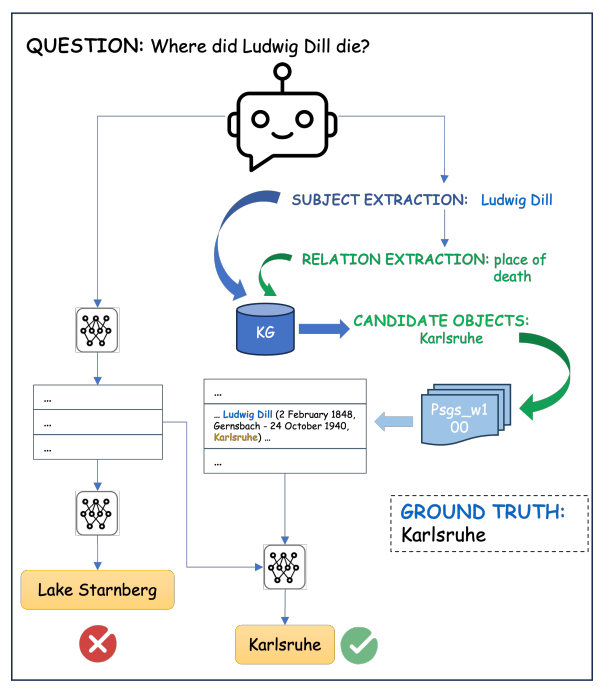
Microsoft's GraphRAG is one example. It breaks documents into segments, extracts entities and their relationships, and builds a knowledge graph that can be used during retrieval.
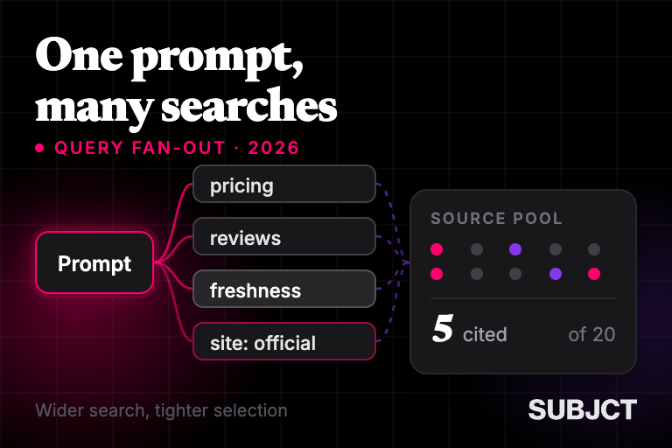
Google has also confirmed that entities form part of its AI search infrastructure. AI Mode combines Gemini with Google's existing systems, including the Knowledge Graph, and uses query fan-out to search across multiple sources.
Entity resolution also helps group different references to the same thing. Google Cloud's entity reconciliation, for example, can use names, entity types, attributes, and relationships to determine when different records represent the same entity, then group them under a stable machine identifier.
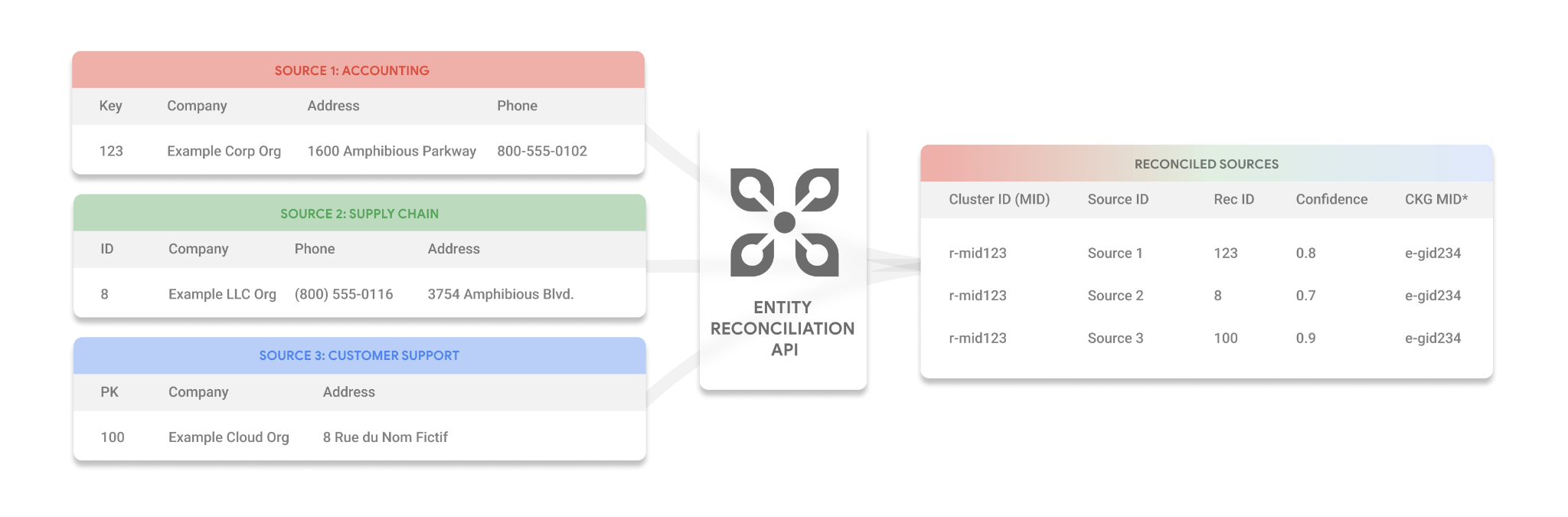
For your site, that makes entity clarity useful before you even get to rankings or citations. If a system can reliably identify the company, person, product, or concept a page refers to, it has a clearer foundation for retrieving and connecting that content.
There is one important caveat. There is no published evidence showing that entity linking by itself is a direct citation or ranking factor for ChatGPT, Perplexity, Gemini, or Google AI Overviews.
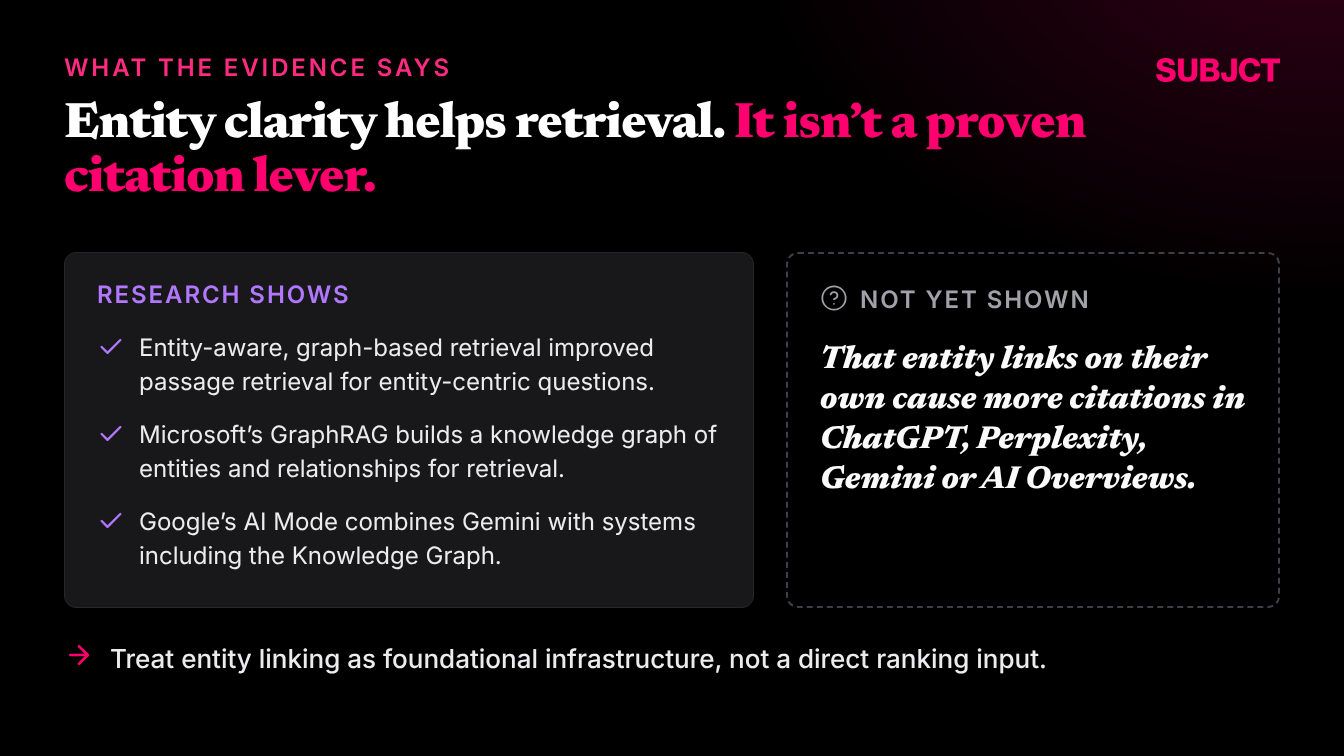
Research cited above shows that entity-aware and graph-based retrieval can improve passage retrieval for entity-focused questions, but that is different from proving that adding entity links to a website directly causes more AI citations.
Entity linking is better understood as a foundational way to make the entities and relationships in your content more explicit for search engines and AI systems.
How to Build Entity Linking Across a Site
Building entity linking across a site comes down to a few repeatable steps.
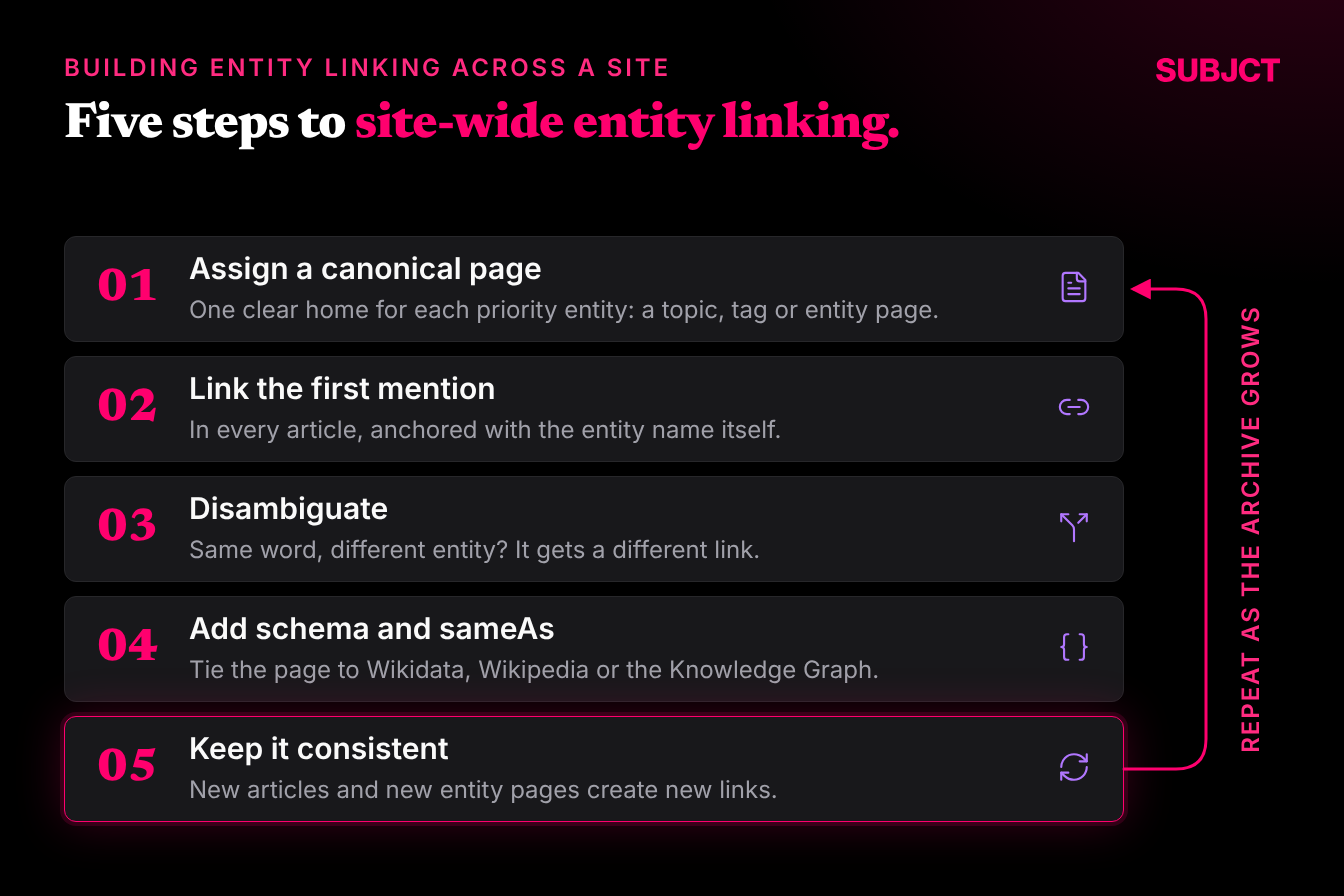
1. Create or assign a canonical page for each priority entity: Every entity you care about needs one clear home, usually a topic page, tag page, or dedicated page about the company, product, person, or concept. If that page does not exist yet, create it first.
2. Link the first relevant mention in each article: You do not need to link every instance. Link the first meaningful mention using the entity name itself as the anchor, rather than generic text such as “read more” or “learn more.”
3. Handle disambiguation carefully: When names overlap, make sure each mention points to the correct entity. Mentions that use the same word should not automatically be treated as the same entity when the context is different.
4. Reinforce important entities with schema and sameAs: Where an entity has an established record in an external knowledge base, use structured data to connect your page to that record and make the identity more explicit.
5. Keep the system consistent as the archive grows: New articles introduce new entity mentions, while new entity pages can create linking opportunities in older content. Maintaining those connections over time is what turns entity linking from a one-off exercise into a site-wide system.
How SUBJCT Automates Entity Linking
Doing this manually becomes difficult once you have hundreds or thousands of articles. New content introduces more entities to track, while existing articles need to stay connected to the right entity pages as the archive grows.
SUBJCT can also categorise your content using the IAB taxonomy and compare that coverage with competitors to identify gaps.
For entity linking, SUBJCT automates the process across the archive:
- It maps your entities first. SUBJCT analyses the entities across your archive, identifying organisations, people, products, places, and events and showing where they appear across your content.
- It links entities to their topic pages automatically. Once your topic or tag pages are configured, SUBJCT links the first appearance of each relevant entity to its corresponding page. It can also identify semantically related mentions rather than relying only on exact keyword matches, while linking each entity once per article rather than repeatedly throughout the content.
- It connects the schema layer. Through Schema and Knowledge Graph, SUBJCT generates entity-aware JSON-LD and links the main entities on a page to their Google Knowledge Graph identifiers.
- It keeps every link editable. You can change the URL, update the anchor text, or remove a link entirely, so the linking can be automated without taking control away from your team.
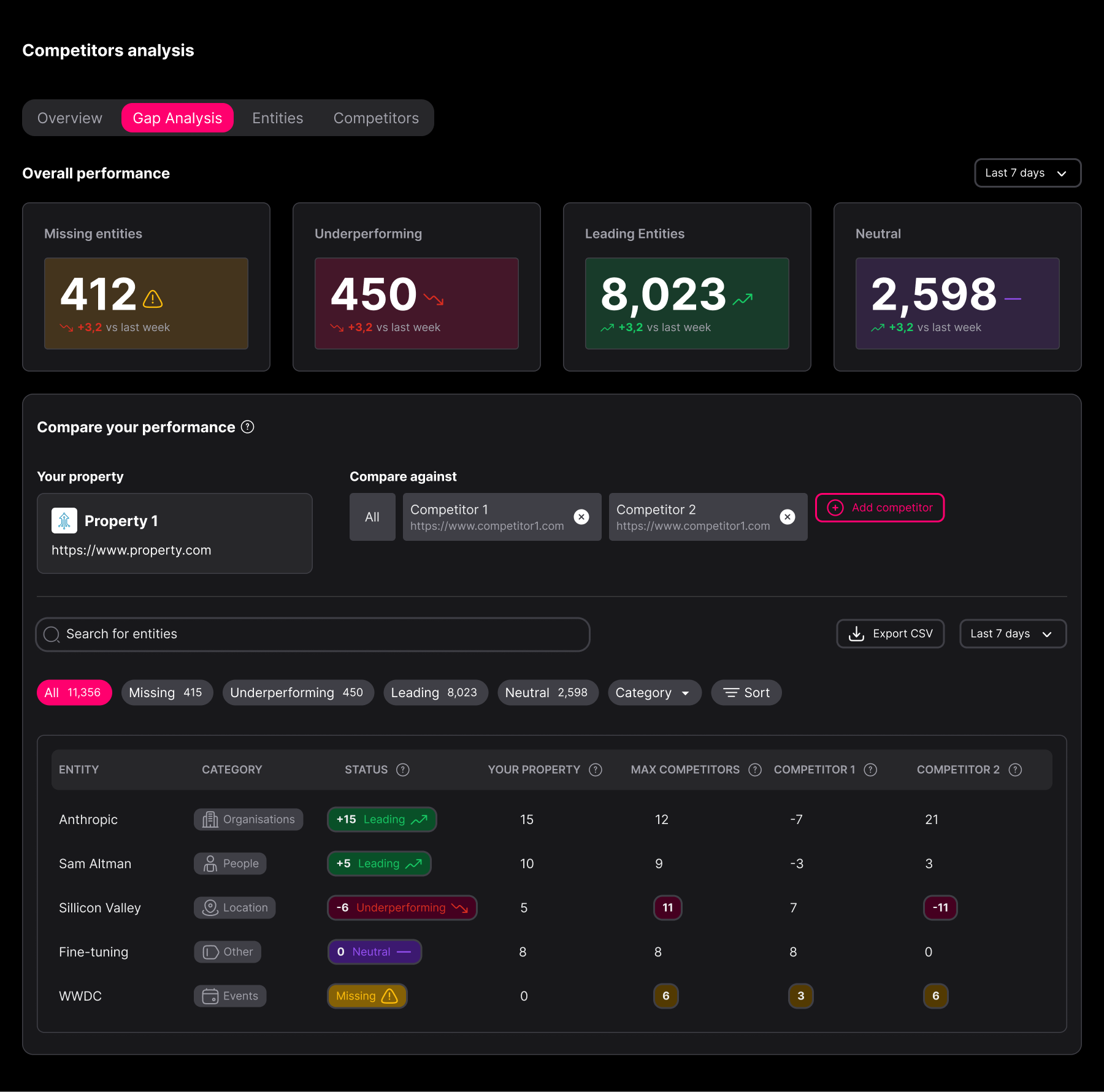
The main advantage is scale. The same entity analysis powers the linking and schema layers, so those connections can be applied consistently across an entire archive rather than maintained article by article.
Frequently Asked Questions
What is the difference between entity linking and internal linking?
Internal linking is the broad practice of linking pages on the same site, usually article to article, to build topic clusters and guide readers. Entity linking is a specific type that connects a mention of a thing, like a company or product, to the one page that defines it. Internal linking builds topics; entity linking builds a knowledge graph.
What is a content knowledge graph?
A content knowledge graph is the structure you create when every mention of an entity on your site links back to one canonical page about that entity. The result resembles a small knowledge graph: a network of things and the pages that define them, which both search engines and AI systems can read to understand what your site covers.
What is entity disambiguation?
Entity disambiguation is the process of working out which specific entity a mention refers to when the name is ambiguous. "Apple" could be the company or the fruit. Disambiguation uses context, schema, and links to resolve it, and entity linking is one of the strongest signals you can provide.
Does entity linking help with AI search?
Entity linking helps indirectly, by making your entities easier to recognise and disambiguate, which is a prerequisite for being retrieved or cited. Treat it as foundational infrastructure rather than a direct ranking input.
How many times should you link an entity in one article?
Once, on the first relevant mention. Linking every instance clutters the page and adds no extra signal. The first meaningful reference, anchored with the entity name, is enough.

Table of contents

Ready to build AI search optimisation into your stack?
Get in touch to find out more about our suite of content optimisation products built for AI Search.