

11 mins
What Is Topical Authority and How Do You Actually Build It?
TL;DR
- Topical authority determines whether search engines and AI systems recognize your site as a credible source on a subject
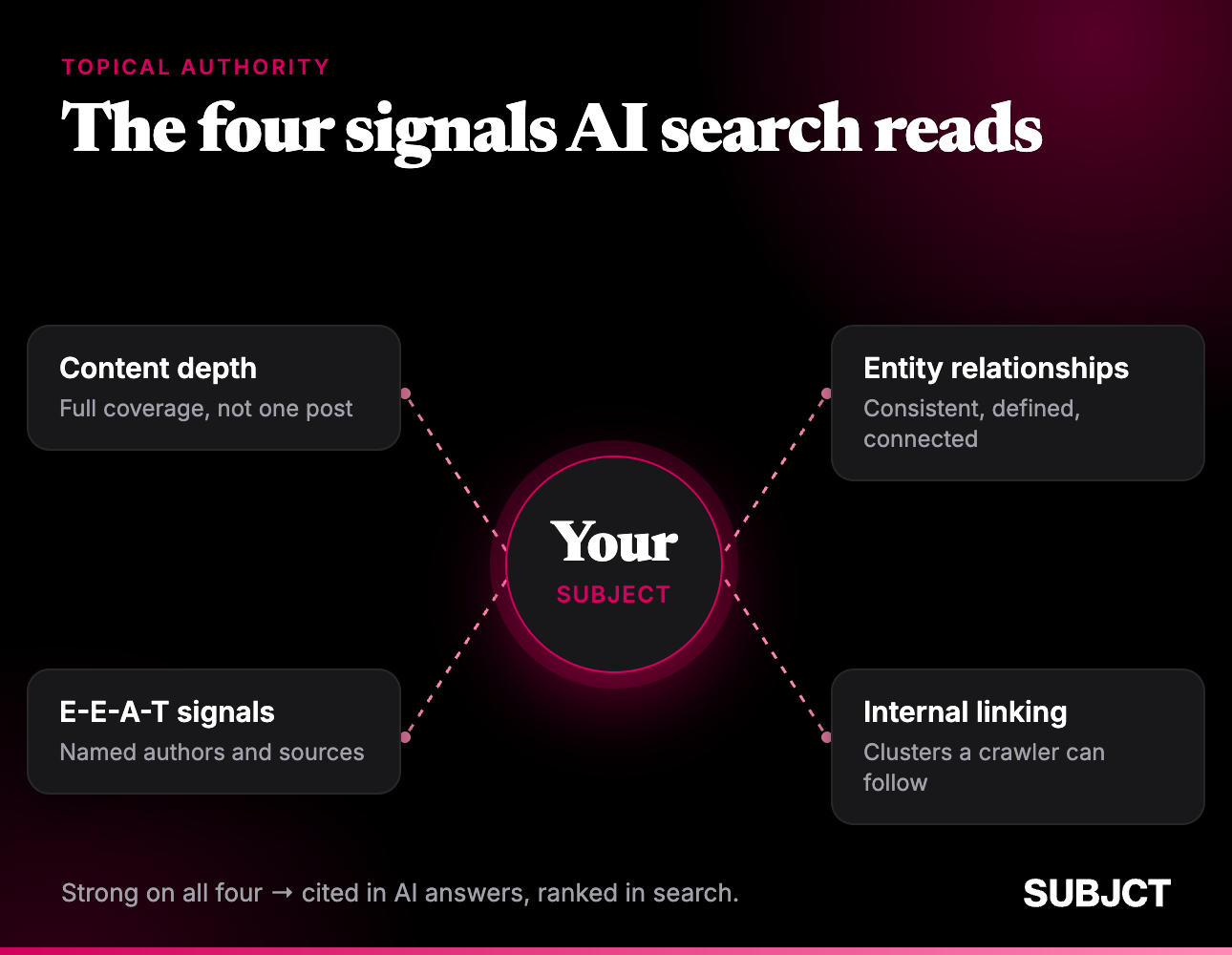
- That authority is evaluated through content depth, entity relationships, E-E-A-T signals, and internal linking structures
- AI platforms like ChatGPT and Perplexity rely on query fan-out and passage-level retrieval to surface sources that demonstrate this authority
- Building authority therefore requires structured content clusters and clear, consistent entity definitions
- When topical authority is strong, sites gain visibility across both traditional rankings and AI citations
What Is Topical Authority in SEO?
Topical authority is how credibly search engines perceive you as an expert on a particular subject.
The idea is simple. When you consistently publish thorough, interconnected content about a specific topic or topics, search engines start recognizing you as a reliable source with expertise in that domain.
I'm not talking about publishing one "ultimate guide" and calling it a day. I mean showing up on the same topic from different angles, till you become a go-to source of information on that topic.
Think about Wikipedia. When you search for almost anything, Wikipedia shows up in the top results.
You can try it now. Search for the keyword "Renaissance art." Wikipedia ranks #1. Search for "blockchain technology." Wikipedia ranks #1. Search for "photosynthesis." Wikipedia ranks highly again.
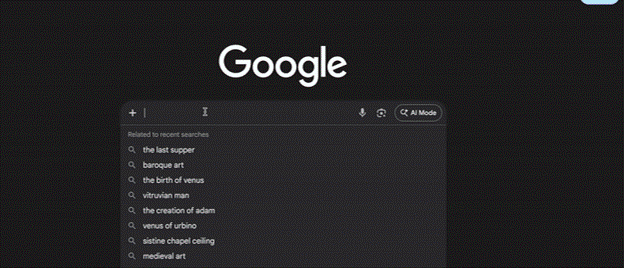
If you were to drop the Wikipedia domain into any SEO tracker or AI visibility tool, you'd notice a massive backlink profile with huge organic traffic.
But here's where it gets interesting.
Wikipedia doesn't rank because of backlinks alone. Other ultra-authoritative publishers also sit in the top tier of the web by link equity, yet none of them dominate entire knowledge areas the way Wikipedia does.
The real reason Wikipedia thrives is that it has built the most comprehensive and internally consistent knowledge graph on the internet.
We're talking about a moat where every topic connects to related concepts through internal links, entities are clearly defined, and coverage is systematic rather than opportunistic.
That's exactly what topical authority means in practice.
Wikipedia however, may not be the best example. They demonstrate topical authority at the broadest scale, meaning that they rank for almost everything because they've created interconnected coverage of nearly all human knowledge.
For smaller sites, the principle is the same but the scope is different. You're not trying to cover everything, rather you're building deep expertise in specific niches.
Take Investopedia. They don't compete with Wikipedia on "Renaissance art" or "Blockchain."
Instead, they focus on finance and investing, where they've published 25,000+ educational articles over 25 years. A simple case of demonstrating genuine expertise in a focused domain.
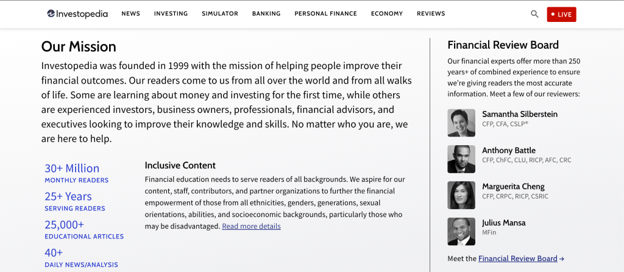
Source: Investopedia
Is it possible to build this same kind of authority in your niche? Definitely.
As we'd see, the above isn't just a theoretical SEO idea or a hindsight explanation we apply to big brands, but a pattern that shows up consistently in how modern search systems evaluate and reward content.
Why Topical Authority Matters
Over the last few years, multiple large-scale studies and Google's own documentation have made it increasingly clear that search systems actively reward sites that demonstrate deep, focused expertise across a topic.
In 2024, a large-scale analysis of almost 260k Google search results examined how on-page factors correlate with rankings after the March core and Helpful Content updates. The study's core finding was that comprehensive topic coverage was the strongest on-page ranking factor they tested.
In another 2023 article, Google openly confirmed the importance of topical authority when it introduced its "news topic authority" system. This system favors publications with demonstrated expertise in specific subject areas, evaluating areas like:
- how notable a source is for a given topic or location
- how influential its original reporting is based on citations from other publishers
- its overall reputation for high-quality coverage
The same principle applies beyond news. Google wants to show users genuine experts, not sites that happened to write one article about something.
A separate study by Graphite analyzing 12 websites and 332 URLs found that pages with high topical authority gained traffic substantially faster than low-authority pages, were significantly more likely to earn early clicks, and reached impression milestones more quickly.
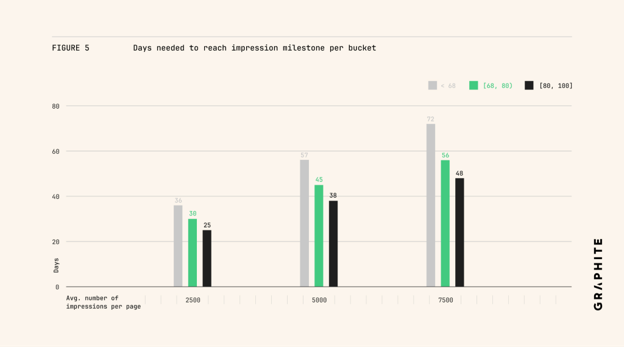
Source: Graphite
Think about what that means in practice. When topical authority is strong, content doesn't have to fight for attention in isolation. It inherits momentum from the rest of the site, reaches visibility sooner, and compounds faster as each new piece reinforces the same expertise signal.
The reverse also holds. When that topical focus starts to spread too thin, performance tends to unravel just as quickly.
A good example comes to mind: HubSpot.
Between November and December 2024, HubSpot's organic traffic dropped from 13.5 million visitors to 8.6 million according to Search Engine Land.
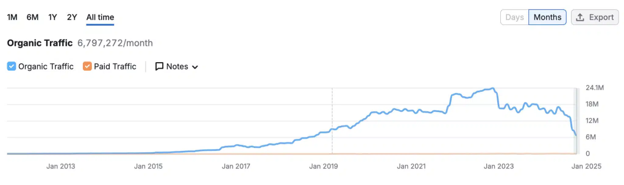
Source: Search Engine Land
HubSpot is widely regarded as a leading example in B2B content marketing, so this naturally attracted a lot of attention and speculation.
SEO consultant Gaetano DiNardi on LinkedIn said: "The game has changed. No one is safe, not even a mega brand like HubSpot. Google doesn't really want you publishing topics that are "too far astray" just for the sake of getting traffic. Why publish these topics anyway? Extreme top of funnel is not worth it."
More analysis pointed to HubSpot's content strategy. They'd been ranking for things like famous quotes, resignation letter templates, and career advice. These drove traffic, but didn't connect to their actual business selling CRM and marketing software.
When Google's December 2024 updates rolled out, sites publishing outside their core expertise saw drops. HubSpot's situation suggested even established brands aren't protected.
In other words, topical authority doesn't appear to be a vague brand halo effect. It looks increasingly like something that's measured, reinforced, and withdrawn based on how consistently a site demonstrates expertise in a defined domain.
When content drifts too far from that core, even strong domains can lose the advantage they once had.
That shift becomes even more obvious once you look at how AI-driven search systems retrieve and evaluate information today.
How AI Search Evaluates Topical Authority
For years, visibility meant competing for a spot in the ten blue links. That mental model held up until large language models (LLMs) entered the search experience and changed how information is retrieved and presented.
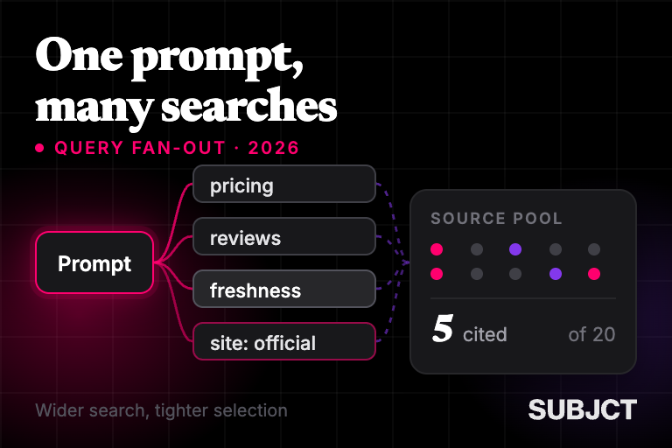
When you ask a question in systems like Google AI Mode or ChatGPT, the system doesn't just look up your exact phrasing. It generates dozens of synthetic queries in parallel.
Google's Search with stateful chat patent outlines this process: the system analyzes context, then reformulates your intent into related, implicit, and recent queries, each retrieving documents independently.
Those documents are scored based on how well their embeddings align across the full set of synthetic queries, not just the original one. Specialized AI models then synthesize everything into one response.
The implication is straightforward. Your content can't just target one keyword anymore. It needs to be retrievable across an entire web of related queries, which only happens when a topic is covered comprehensively from multiple angles.
Sites with broad, connected coverage surface more often because they appear across more of those synthetic queries.
Back to the HubSpot example. Yes, individual pages could still rank well in isolation, but when large portions of content sit outside a brand's core domain, they stop reinforcing the same entity cluster. And in an AI-driven retrieval system, that matters.
Another patent describes passage-level selection, where AI systems don't read your full page, but extract specific passages semantically similar to all those synthetic queries.
That's why structure matters. Short, focused paragraphs, clear headers, and one idea per section make passages easier to isolate, reuse, and cite. When structure is messy, extraction quality drops.
On top of that, brand recognition acts as a trust signal. When AI systems decide what to cite, they lean on brands they recognize from training data and external mentions, treating them as more reliable sources.
That authority isn't built on your site alone. Industry publications, contributions to established platforms, podcasts, and conference appearances all shape how AI systems decide what to cite.
When you build proper topical authority with comprehensive entity coverage, clear relationships, and strategic structure, you're simultaneously building for traditional search and AI visibility.
How Search Engines Determine Topical Authority
Google doesn't have a single "topical authority score" that shows up in Search Console.
The measurement happens through multiple signals (and algorithms) that, when combined, indicate whether your site is a credible source on particular subjects.
Let me break down how this actually works.
Content Breadth and Depth
The first signal is straightforward: how much of a topic have you covered, and how thoroughly?
Coverage has two dimensions that both matter.
Breadth means covering the full scope of a subject. For a home fitness site, that means addressing the major subtopics, from strength training and cardio to flexibility, basic nutrition, recovery, injury prevention, and workout planning, rather than fixating on a single narrow angle.
Depth means going beyond surface-level explanations. A 600-word overview of weight training is breadth. A 3,000-word guide that breaks down beginner routines, proper form for major lifts, progressive overload, common mistakes, recovery schedules, and real-world training examples is depth.
Entity Relationships and Knowledge Graph Alignment
This connects directly to how Google uses entities to understand content.
This approach is often referred to as entity SEO: optimizing content around real-world entities and their relationships, rather than isolated keywords.
Topical authority exists in the Knowledge Graph as a network of relationships between your site and the entities you consistently discuss.
When Google processes your content, it extracts entities, measures entity salience (how central each entity is to the page), and maps how those entities relate to one another.
Over time, those signals accumulate. If your site consistently covers the same set of related concepts, Google begins associating your domain with that topic space.
That's why one-off articles rarely build authority. Topical authority emerges when a site repeatedly demonstrates an understanding of how entities within a domain fit together, across multiple pieces of content, rather than touching a topic once and moving on.
When that entity usage is consistent and well-connected, it becomes easier for both Google and AI systems to recognize what your site actually specializes in.
E-E-A-T Signals
E-E-A-T stands for Experience, Expertise, Authoritativeness, and Trustworthiness, according to Google's Search Quality Rater Guidelines.
Here's how each component maps to topical authority.
- Experience — firsthand knowledge. If you're writing about project management software, showing screenshots from actual implementations, discussing specific workflow challenges you've solved, and sharing real usage data all signal experience.
- Expertise — deep subject knowledge. You don't necessarily need formal degrees, but you do need to show deep understanding across multiple articles that build on each other. When readers think "this person genuinely knows this subject" after reading several articles, that's expertise showing through.
- Authoritativeness — external recognition. When other credible sites link to you, cite you, or mention you as a reference source, that builds authority. Being quoted by industry publications, speaking at events, and recognition from respected organizations all help build authority.
- Trustworthiness — accuracy and reliability. Citing reputable sources, updating content regularly to keep advice current, and showing clear author attribution all strengthen trust signals.
Topical authority and E-E-A-T reinforce each other, creating a compounding effect on how Google evaluates your content.
How to Build Topical Authority: Step-by-Step
Let me walk through how this works in practice.
1. Topic and Entity Mapping
Start by defining which topics you want authority on. These are the specific areas where you have genuine expertise and can create comprehensive coverage.
For each topic, map the core entities. If your topic is travel planning, your entities might include:
- Travel planning (primary concept)
- Destinations (locations)
- Flights and trains (transport types)
- Hotels and rentals (accommodation types)
- Itineraries (planning artifacts)
- Travel insurance (financial product)
- Packing lists (preparation task)
- Local attractions (points of interest)
The goal is creating a complete map of entities within your topic and understanding how they relate to each other.
2. Content Gap Analysis
Once you know which entities matter, audit what you already have.
You can run your existing content through SUBJCT entity analysis to see which entities you've covered, which you've mentioned in passing, and which are missing entirely.
3. Structured Content Creation
Create content in clusters. Start with a pillar page for your core topic. This should be comprehensive, well-structured, and definitively cover the main entity.
Then build cluster content around related entities. Each cluster page should:
- Focus on one specific subtopic
- Link back to the pillar using the main entity name as anchor text
- Link to related cluster pages using specific entity names
- Include original examples, data, or insights (information gain)
- Use clear formatting that enables passage extraction
The structure should mirror how concepts actually relate to each other, not just how keywords relate to search volume.
4. Internal Linking Strategy
Every internal link tells Google that two entities are related. The anchor text and surrounding context provide additional semantic information about the nature of that relationship.
Strategic (and semantic) internal linking means:
- Using entity names as anchor text (not generic phrases like "click here")
- Linking from related entities bidirectionally (not just cluster to pillar)
- Creating contextual links within body content (not just in headers or footers)
- Maintaining consistent entity naming across all links
How SUBJCT Automates Topical Authority
Building topical authority manually works when you have like 10 or 20 articles. When you have 500 or 5,000, manual entity mapping, gap analysis, and semantic internal linking becomes impossible.
That's the problem SUBJCT solves.
SUBJCT does this through its Entity Analysis, Automated Article Tagging, and Automated Internal Linking offerings.
Together, they analyze your full content archive, extract entities, highlight topical gaps, and identify where related pages should be connected.
Instead of manual audits and spreadsheets, SUBJCT applies entity-led tags and builds contextual internal links based on semantic relationships, not keywords. This creates consistent entity clusters across hundreds or thousands of pages.
Get in touch to see how this works for your content operation.
Frequently asked questions
Do topic clusters still work?
Yes, topic clusters still work for building topical authority. However, execution matters more than structure. Topic clusters work when they represent genuine comprehensive coverage with deep content and clear entity relationships. Formulaic clusters with thin content don't build authority.
Can I build authority in multiple unrelated topics?
Technically yes, you can build authority in multiple unrelated topics, but it requires keeping topics completely separated and exceptional content volume. For most sites, scattered focus dilutes authority signals. Better to dominate 2-3 related topics than spread resources thinly across many unrelated ones. Focus creates compounding advantages that scattered strategies can't match.
What's the difference between topical authority and domain authority?
Domain authority (a Moz metric) estimates overall site strength based primarily on backlink profile. Topical authority measures perceived expertise on specific subjects based on content depth, entity coverage, and semantic coherence.
How does topical authority affect AI citations?
Sites with strong topical authority get cited more frequently because they appear in results for multiple related sub-queries generated during query fan-out, provide passage-level content that's easily extractable, and have brand recognition that signals trust.

Table of contents


Ready to build AI search optimisation into your stack?
Get in touch to find out more about our suite of content optimisation products built for AI Search.
.png)

Content Optimisation Built for AI search.