

13 mins
Query Fan-Out in 2026: How AI Engines Retrieve and Select Sources
TL;DR
- Query fan-out turns one prompt into several related searches, but each AI engine can take a different route.
- Models often add their own criteria, such as pricing, reviews, freshness, features, and official sources.
- Fan-out also shapes source selection, with many searches targeting specific websites from the start.
- More searches widen the source pool, not necessarily making the final answer longer.
Introduction
When you ask an AI system a question, the final answer is not always built from your exact wording alone.
The system may first break your prompt into several related searches (decomposition), gather information across those searches (retrieval), and then combine the results into one response (synthesis). Most of that process happens before the answer appears on screen.
This phenomenon is popularly known as query fan-out. This article examines how fan-outs are formed, how they shape retrieval and source selection, and what that means for brands.
What is Query Fan-Out?
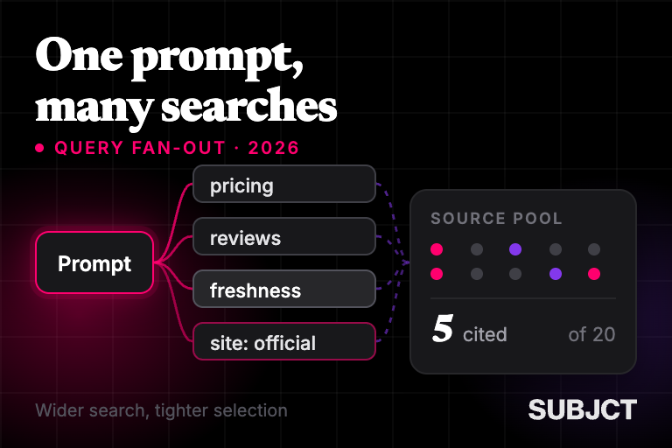
Query fan-out is the process of expanding one user question into several related searches that collectively help an AI engine construct an answer.
Google introduced the term at I/O 2025, describing the technique as "breaking down your question into subtopics and issuing a multitude of queries simultaneously on your behalf."
The same pattern appears across other LLMs like Claude, Gemini, and Perplexity. OpenAI, for example, describes ChatGPT as "rewriting your query into one or more targeted queries," depending on contextual factors such as personalisation or location.
Suppose you ask: "Which accounting platform is best for a small business?"
The system may take that query and fan it out into searches covering:
- current pricing and plan limits
- payroll or invoicing features
- integrations with other platforms
- independent software reviews
- official product documentation
For a product recommendation like this, the system is gathering and assessing information from across the web to make a more informed recommendation.
It's important to note that these searches are not simply synonyms for the original query, as some explanations suggest. They can be rewritten, reformulated, personalised, and expanded to address needs the user may have implied without stating directly.
How the Same Prompt Unfolds Across AI Engines
When you hear the term "fan-out," it's easy to imagine a huge research tree, with one prompt multiplying into dozens of related searches. That can happen during deep or agentic research, but it's not always how the process unfolds.
This became clear during my analysis of 1,500 prompts run through GPT-5.6 Terra. The controlled practitioner study covered ten industries and produced 4,719 generated searches and 4,533 citation appearances across 955 domains, with each prompt run once.
I will return to the wider findings later in this article. For now, a smaller experiment helps show how differently fan-out can work across AI engines.
For this article, I asked ChatGPT 5.6 Sol, Claude 4.8 Opus, Gemini 3.1 Pro and Perplexity Pro the following question:
"What is the best cordless vacuum for a three-bedroom home with pets, carpets and hard floors, under £400?"
The results were broadly similar at the brand level but different in their visible research approaches.
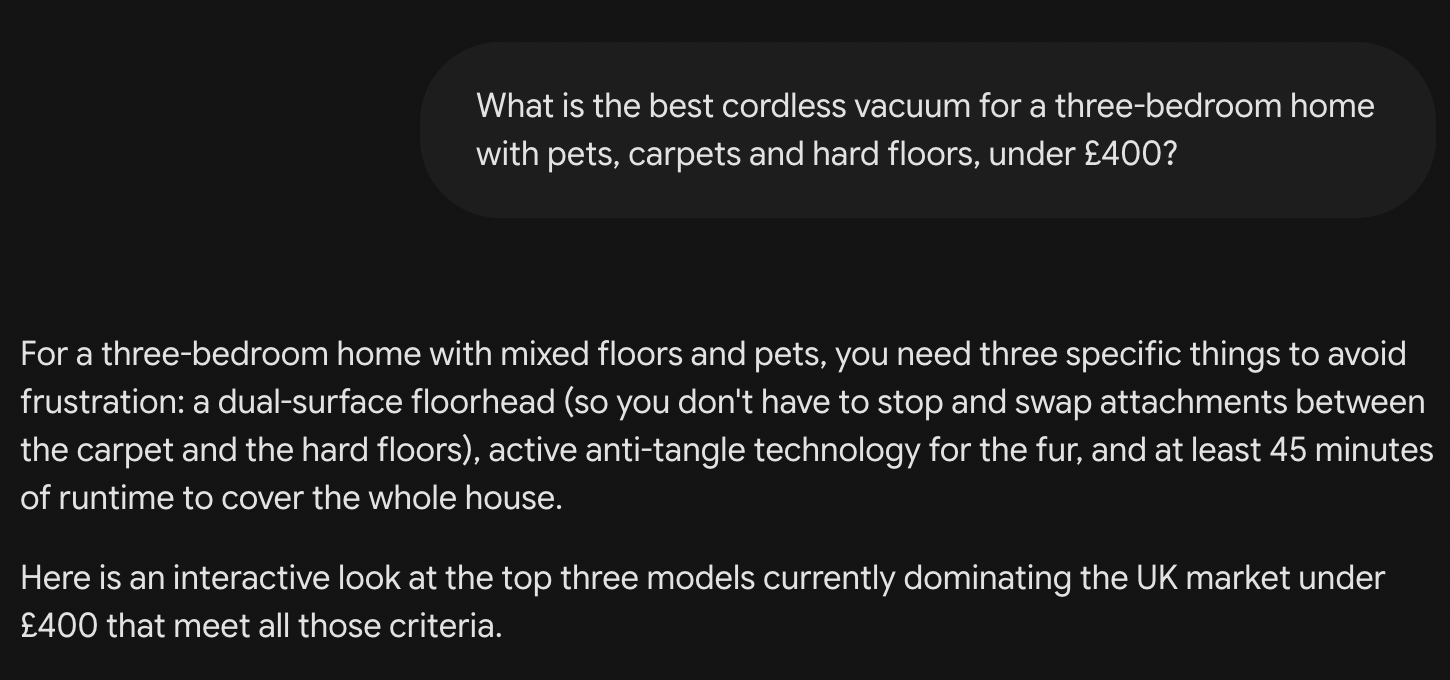
- ChatGPT 5.6 Sol — Searched selected review publishers and manufacturer domains, then compared current products, specifications, and prices. Main recommendation: Shark PowerDetect IP1251UKT.
- Claude 4.8 Opus — Began with a broad search, questioned the usefulness of several results, then narrowed towards stronger independent testing and pricing. Main recommendation: Shark Stratos IZ400UK.
- Gemini 3.1 Pro — Turned the prompt into criteria around mixed-floor handling, anti-tangle performance, and minimum useful runtime. Main recommendation: Shark Stratos Pet Pro, including the IZ420UKT and IZ411UKT.
- Perplexity Pro — Built a citation-heavy comparison and separated alternatives by value, emptying method, and battery flexibility. Main recommendation: Shark Stratos IZ400UK.
All four placed a Shark vacuum at or near the top, suggesting a strong consensus. But on closer inspection, each system took a different route.
ChatGPT searched review publishers and manufacturer websites directly.
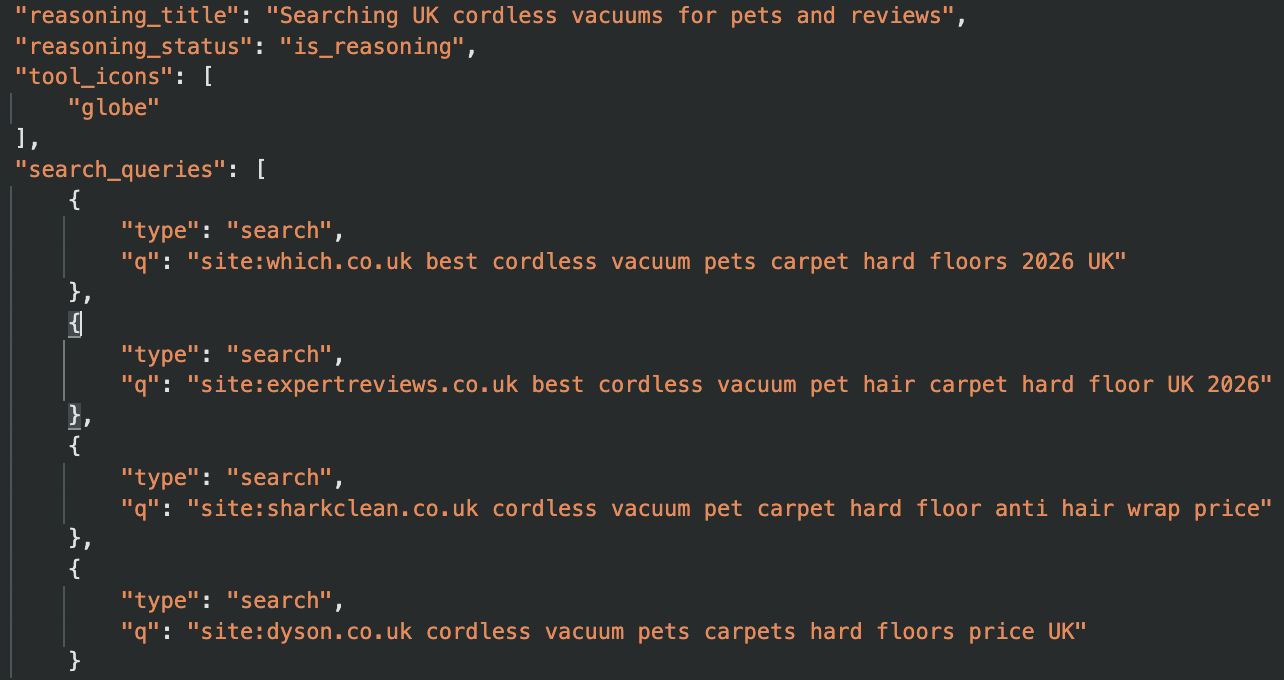
Claude began with a broad search, questioned the quality of the initial results, and then asked me to clarify the request before continuing.
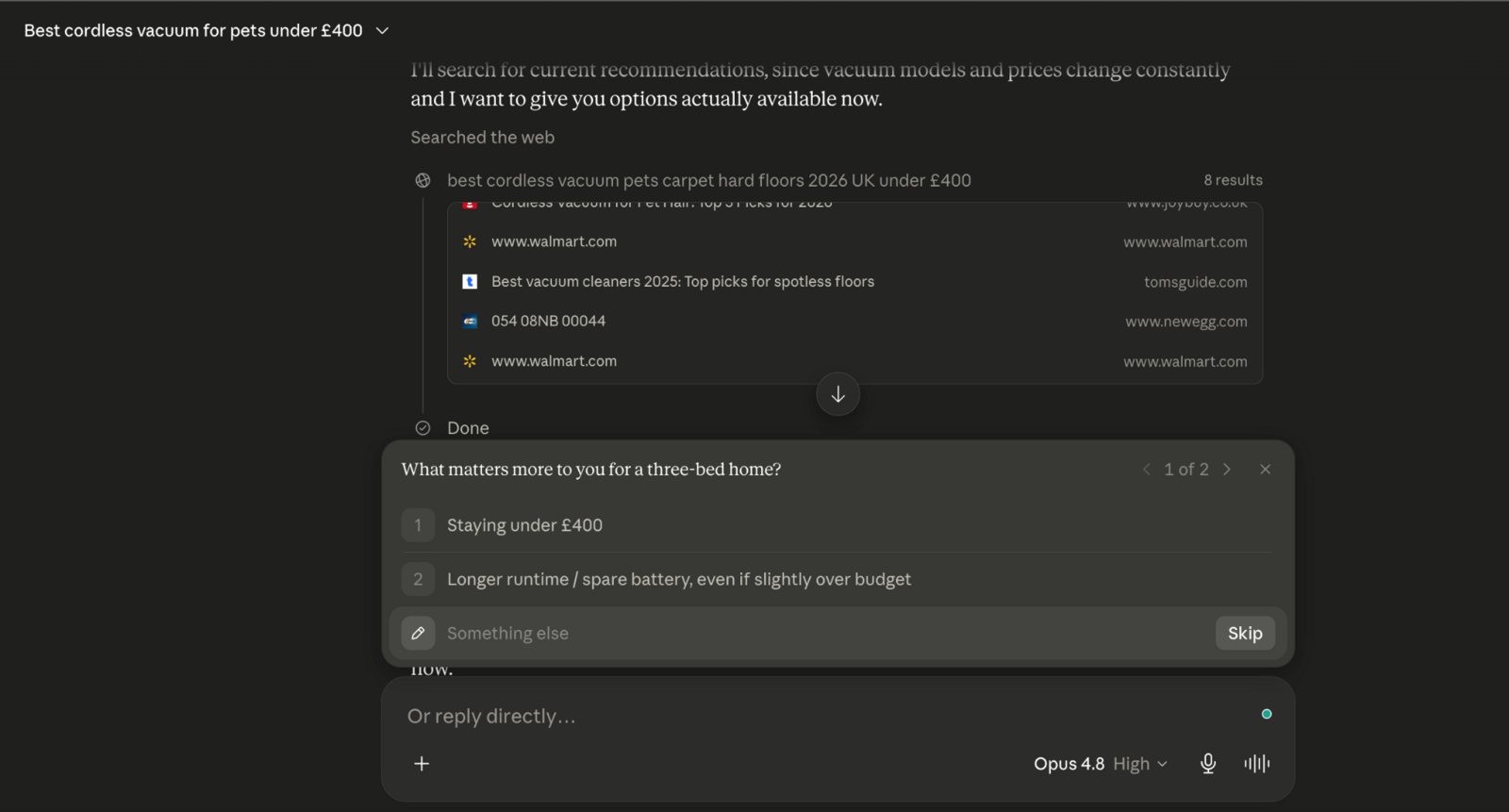
Gemini turned the prompt into a set of product requirements before making a recommendation.
Perplexity assembled a citation-heavy comparison before offering several decision paths.
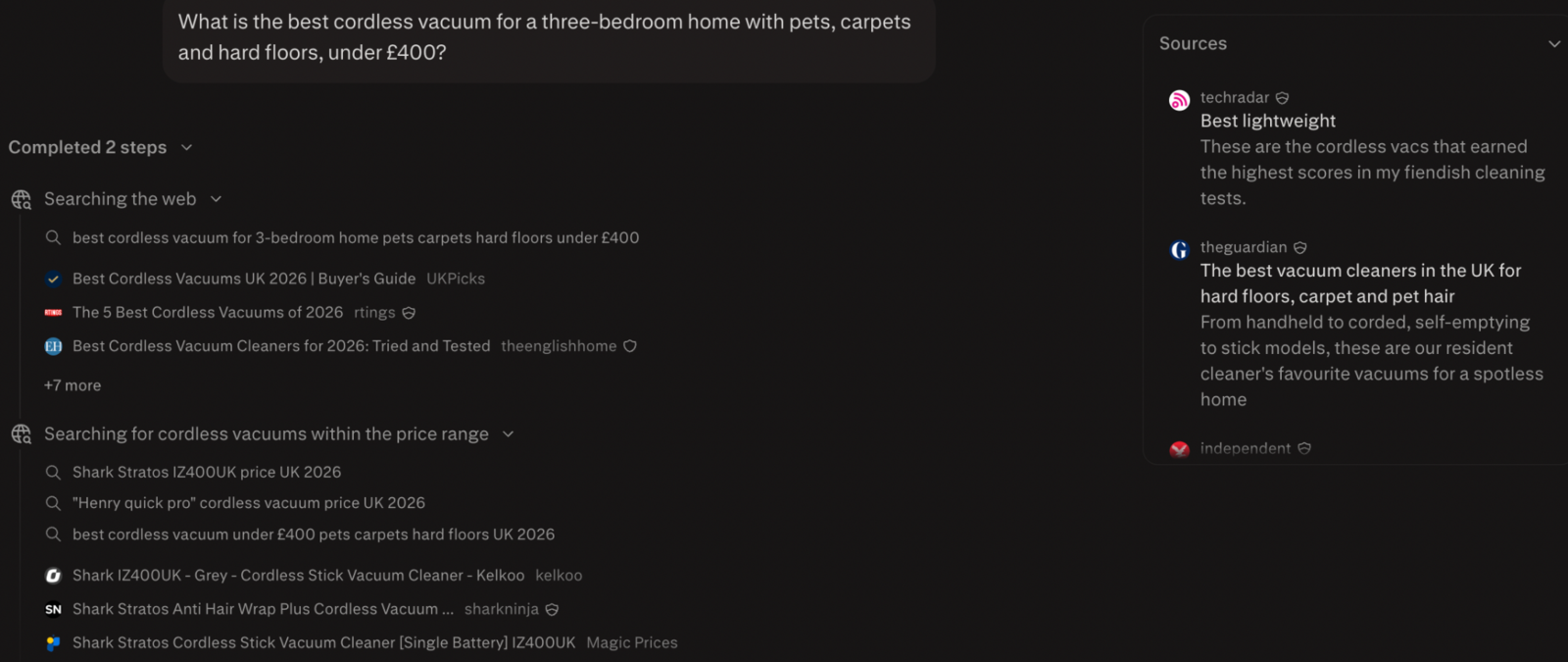
So, although the prompts were identical, each engine interpreted the research task differently.
This is what gets lost when query fan-out is described as a simple list of keyword variations. There is no single pattern shared by every AI engine. The searches, sources, and sequence can differ even when the final recommendations look similar.
AI Engines Add Criteria the User Never Asked For
Up to this point, we've seen how LLMs rewrite and reformulate queries to resolve the different information needs behind a complete answer.
But as established earlier, they don't always work only with the requirements provided in the prompt. They also tend to introduce additional criteria they consider useful, possibly shaped by the context of the question and patterns learned during training.
These criteria often appear as modifiers added to the generated query, which can make the full query look quite strange.
For example, a question such as:
"Which Nintendo should I buy?"
could produce a fan-out such as: "site:nintendo.com Nintendo Switch 2 official price features".
In the example above, every added term has a job. The site: operator directs the search towards Nintendo's website. "Official" signals a preference for first-party information, while "price" and "features" identify the facts needed to assess the product.
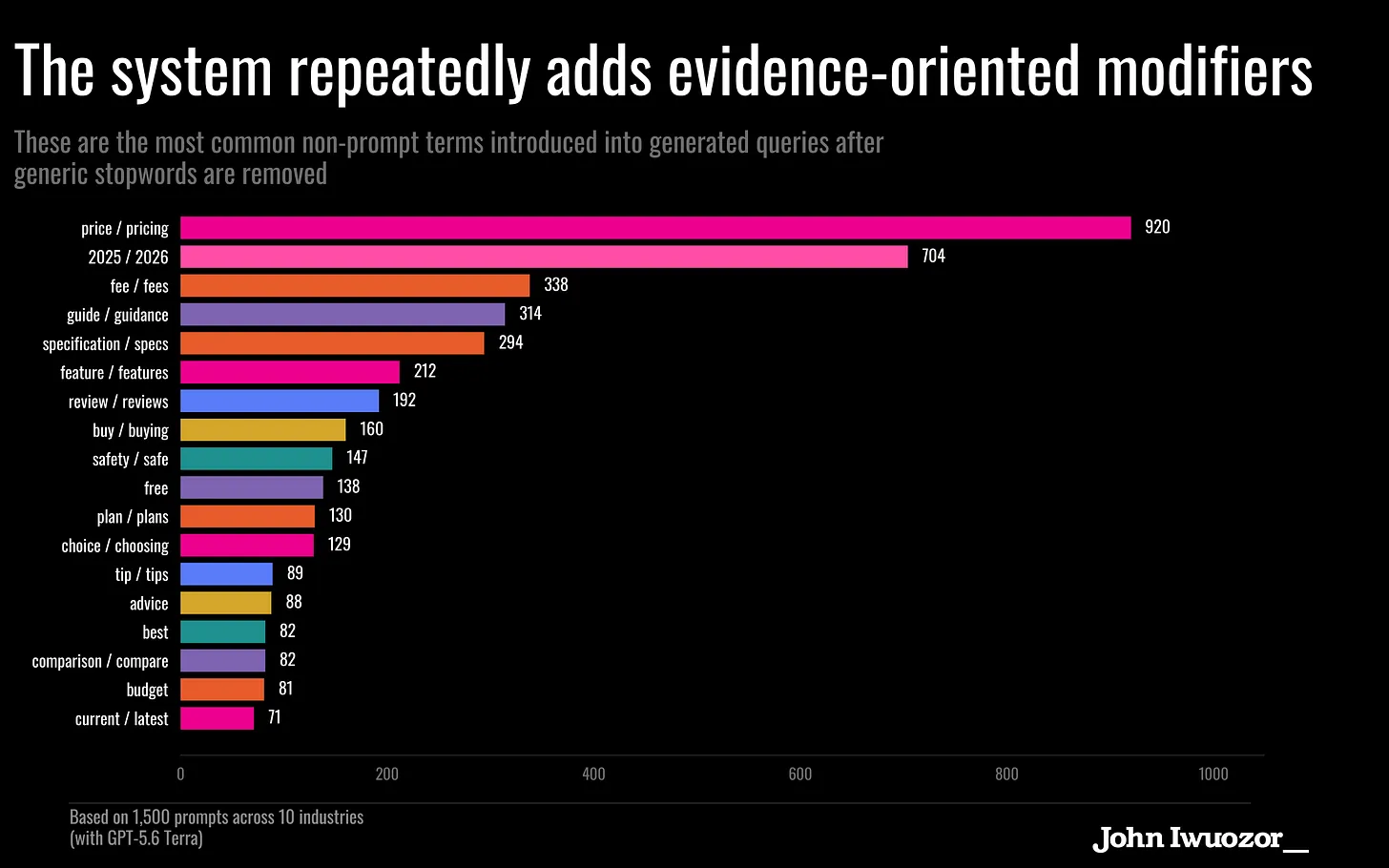
This was not an isolated pattern. When I pulled apart the 4,719 generated queries in my ChatGPT study, the same added terms kept appearing:
- Official appeared in roughly three of every ten queries.
- Price and pricing appeared in about one in five.
- A current-year reference (2025 or 2026) appeared in about one in seven.
- Behind them came features, specifications, reviews, fees, safety and guidance.
I found a similar pattern in a separate test of 50 commercial prompts on Claude Opus 5. Its 161 fan-out queries averaged 3.22 per prompt, usually moving from broad category discovery into pricing and product comparisons.
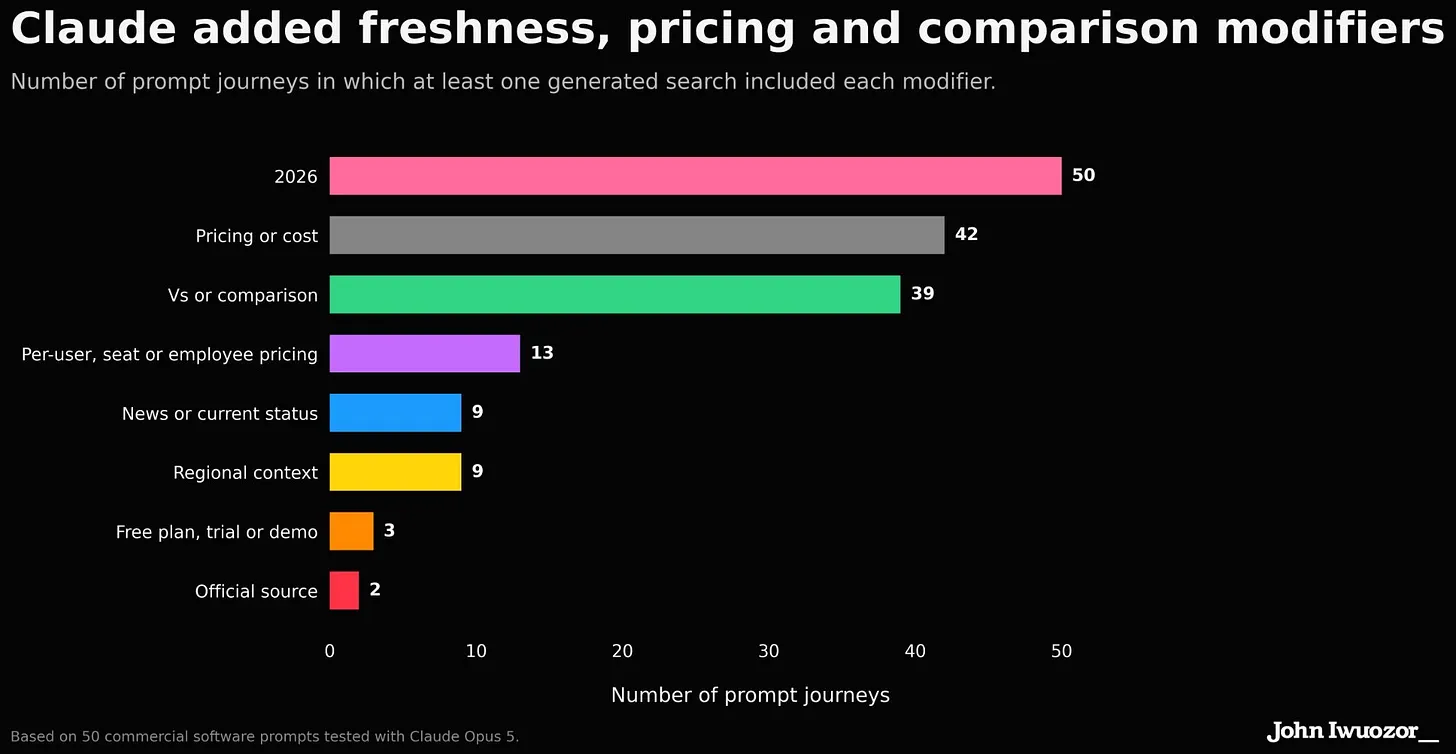
A 2026 modifier appeared in every prompt journey, while pricing or cost language appeared in 42 and "vs" terms appeared in 39.
Together, these words show that LLMs are reaching for information that is current, specific, and easy to confirm.
It's also important to understand that "official" can refer to different kinds of authority. It may mean first-party factual authority, institutional authority, or independent evaluative authority. These do not always point to the same type of source.
In my classified source data, brand and retailer websites made up 59.3% of source appearances. These pages were usually used for product facts such as pricing, features, plan limits, specifications, and availability.
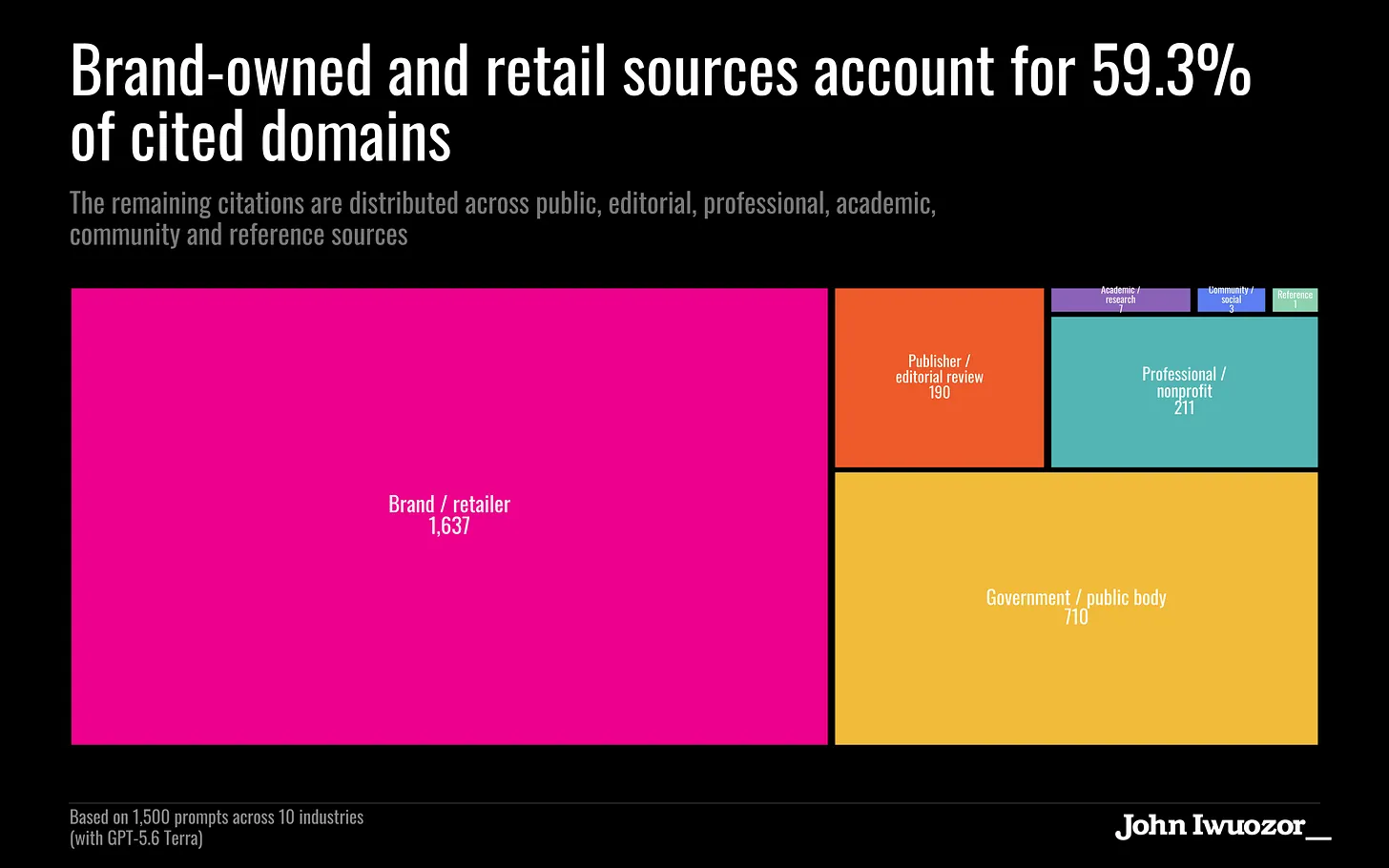
Government bodies, professional organisations, and nonprofits contributed another 33.4%. They were more likely to support claims around safety, regulation, eligibility, consumer protection and professional guidance.
Independent publishers, review sites and testing organisations added another layer by helping the model compare options, assess performance and check whether products worked as claimed.
So the model may use a brand to establish what a product offers, an institution to confirm whether a claim is credible, and an independent source to judge how well the product performs.
In practice, query fan-out does more than expand the wording of a question. It also helps determine what evidence should count before the answer is written.
Query Fan-Out is Also a Source-Selection Process
You may have noticed that both the ChatGPT vacuum searches and the Nintendo example used the site: operator.
That operator tells a search engine to look only within a particular website. A query such as:
"site.co.uk cordless vacuum pet carpet hard floor anti hair wrap price"
is not searching the whole web for information about Shark's cordless vacuums. Instead, it's looking solely within Shark's website for that information.
This appeared far more often than I expected. Of the 4,719 generated searches in my study, 3,619 used the site: operator. That represents 76.7% of all searches.
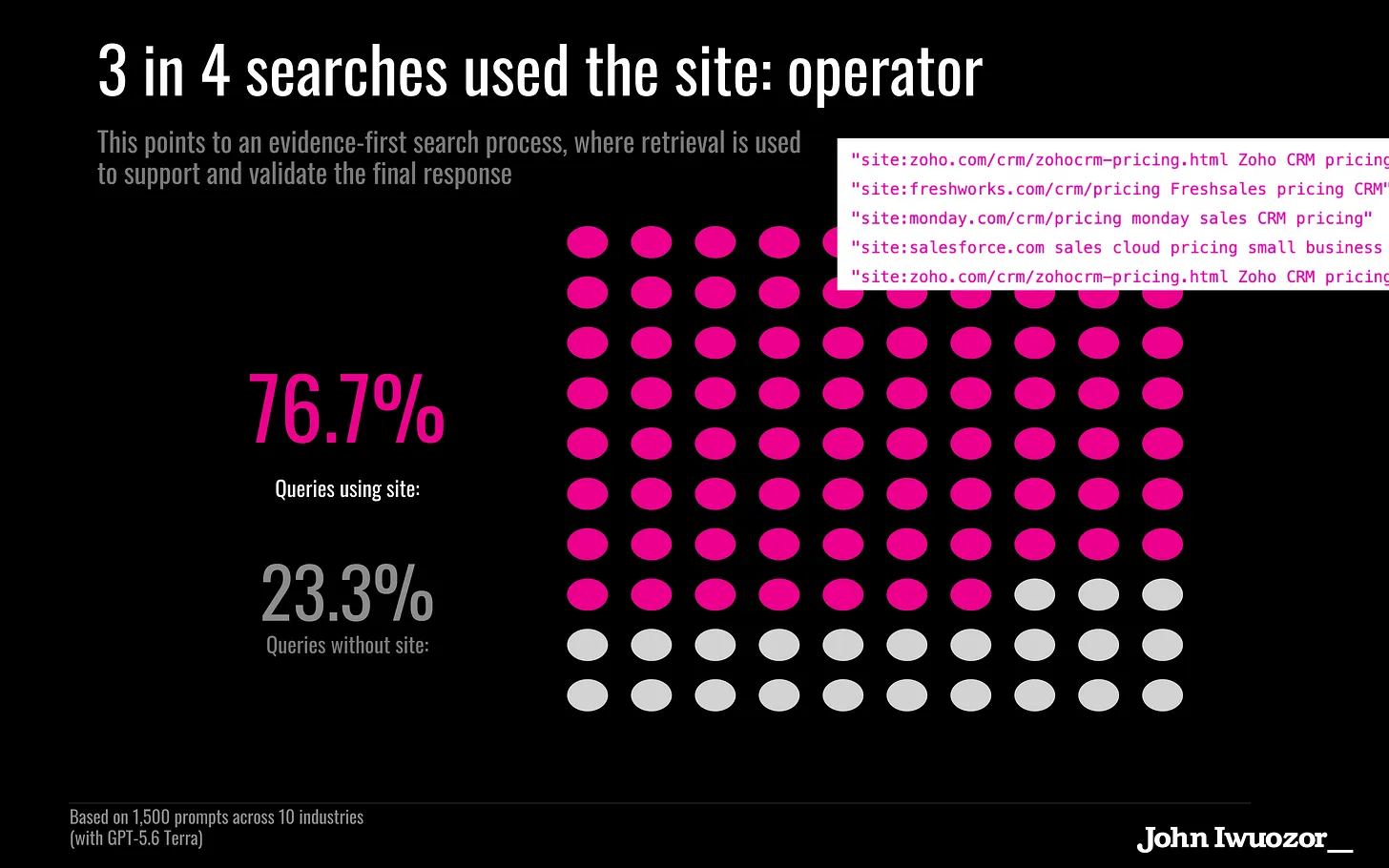
It also appeared early in the process. In 716 of the 1,100 responses that searched, the first query already targeted a specific website.
So, query fan-out is not always a case of searching broadly and then choosing which sources look useful. In many cases, the model appears to have a source in mind before the search begins.
One important caveat is that site: usage can move sharply between model versions. Writesonic found that it fell from 40.5% of fan-outs on GPT-5.4 Thinking to 12.6% on GPT-5.5 Thinking. A later test found it back at roughly 71% on GPT-5.6 Sol.
Both studies used relatively small prompt sets, so I would treat the exact percentages as directional. The broader point is that source-targeting behaviour is not fixed. It can change considerably between models and releases.
What Happens After the Search?
Once the fan-out queries have been generated, the system still has to decide what to do with the results.
It may retrieve several pages, compare the information inside them, discard weak or repetitive evidence, and keep only the material that helps answer the original question. This means appearing in the search path does not automatically mean appearing in the final response.
The important unit here is often not the full page, but the specific passage that answers the query. A page may be broadly relevant to the topic and still fail to provide a clear enough section for the model to use.
This is where retrieval becomes more important.
The system is not only asking, "Which page is relevant?" It's also trying to find the exact part of that page it can actually use. And that helps explain why more searches do not always lead to longer answers.
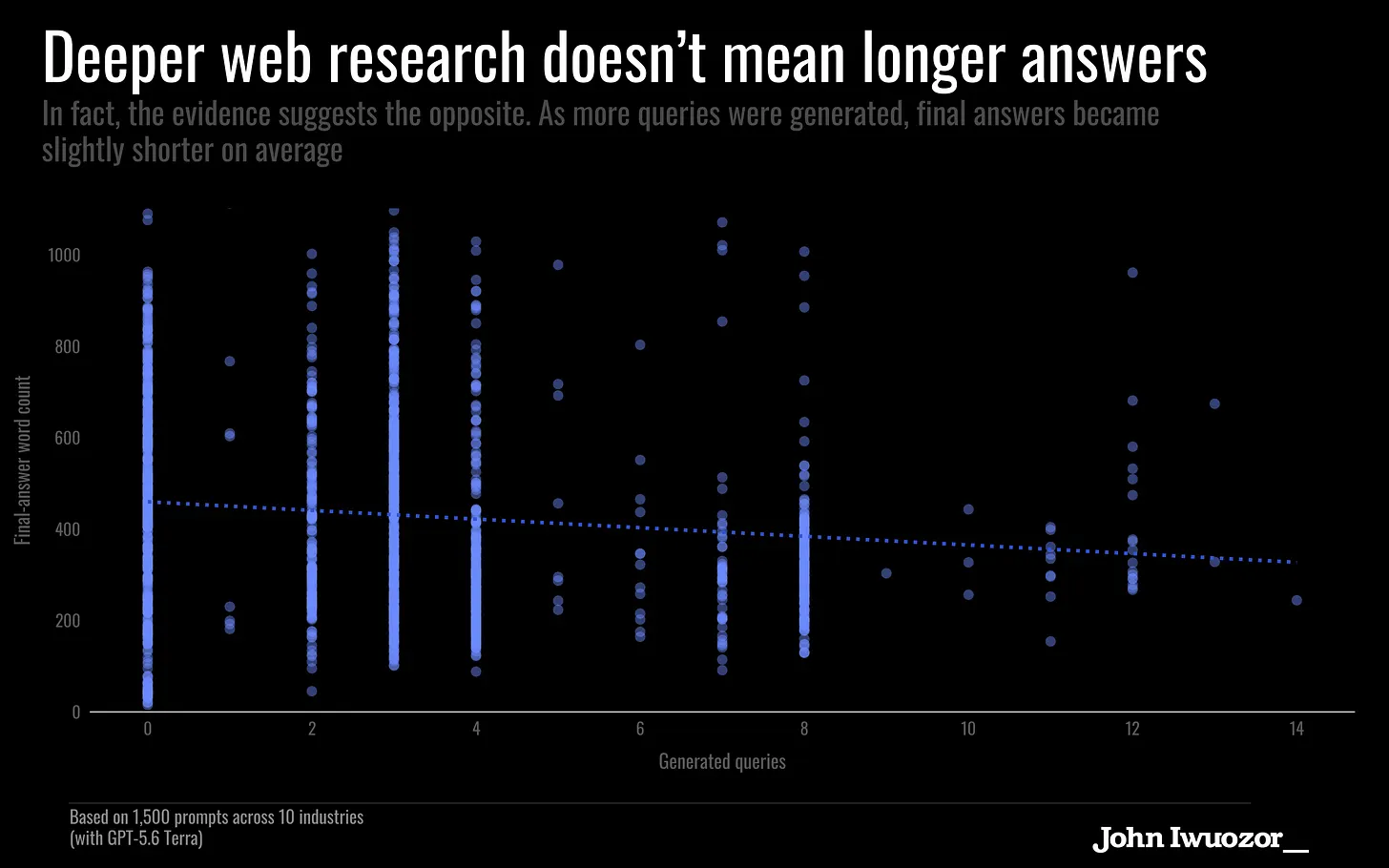
I checked this across the responses that fanned out, and the relationship between query count and answer length was actually slightly negative. The Pearson correlation was about -0.19, which means responses with more generated searches were not generally longer. If anything, the opposite showed up.
Where the stronger pattern appeared was in the number of sources used. The correlation between query count and unique cited domains was about 0.61. So as the number of searches increased, the model was also more likely to pull evidence from a wider set of websites.
I am not suggesting that every extra search causes another citation. More complex prompts may simply require more fan-out and source retrieval.
But the wider point holds here: deeper fan-out seems to broaden the evidence pool. The model may search more, compare more, and still compress everything into roughly the same amount of text.
What This Changes for Brands
The obvious takeaway is not that you should chase every fan-out query and build a new page for each one. That would get messy very quickly, and most of those queries will change between models and versions anyway.
Here's a better approach:
Make first-party facts explicit
Your website should be the clearest place to confirm basic facts about your own product. From my source data, a lot of these fan-out queries went to brand sites, pulling out verified information such as pricing, features, plan limits, specifications, and availability.
You want to avoid making the model work too hard to find those details. If a plan starts at £49, say that clearly. If a feature is only available on the enterprise tier, say that clearly too. Do not bury important details inside vague marketing copy, sliders or long product pages.
Build comparison pages around real buying decisions
Comparison pages matter because many fan-outs are trying to separate one option from another. In the data, tables appeared in 23.3% of all responses, but comparison prompts produced a table in 149 of 150 cases.
A useful comparison page should go beyond saying your product is better. It should explain where each option is stronger, who each one is suitable for, how the pricing differs, and where the trade-offs appear. The page should help the buyer make a decision, not just repeat your positioning. If the comparison feels too one-sided, the model may look elsewhere for the balanced explanation.
Track mentions, not just citations
Because these outputs can change from one run to another, you need to test the same important prompts repeatedly and track more than the cited domains. Look at whether your brand was mentioned, how it was described, which products appeared beside it, and whether the model recommended it.
A brand can be mentioned several times without its own website being cited once. So citation tracking shows you where the evidence came from, while mention tracking shows you how much space your brand is actually taking up in the answer.
Check who else is explaining your brand
Your website is only one part of the source mix. Review sites, publishers, and communities may be used to compare your product, explain its weaknesses, or decide whether it works as claimed. If those sources are outdated, inaccurate, or thin, they'll shape whatever answer the model spits out.
So part of this work is external. Check how your product is described on comparison pages, review platforms, Reddit threads, industry publications, and partner websites. You may not control those pages, but you can at least identify where the problem lies and decide how to address it.
Keep current information easy to verify
The repeated use of terms such as "official," "price," "pricing," and current-year references shows that the model is often trying to confirm whether information is still valid. Old pricing pages, outdated comparison tables, and product pages without dates create more room for uncertainty.
The same applies when a discontinued feature is still mentioned in an old article or when documentation conflicts with the main website. You do not need to add a date to every sentence. But facts that change regularly should be reviewed, updated, and kept consistent across the pages that mention them.
How SUBJCT Supports the Retrieval Process
Taken together, these recommendations are about making important information easier for retrieval systems to find, interpret, and verify. The challenge is knowing whether your content actually does that, especially across a large website.
SUBJCT begins by breaking an existing page into smaller passages. Rather than evaluating the article as one large block of text, it separates the page into the individual sections a retrieval system would be more likely to work with.
Once the page has been broken down, you can add the prompts you want the article to answer. SUBJCT can also expand each prompt into related questions, helping you see the wider information needs surrounding the topic.
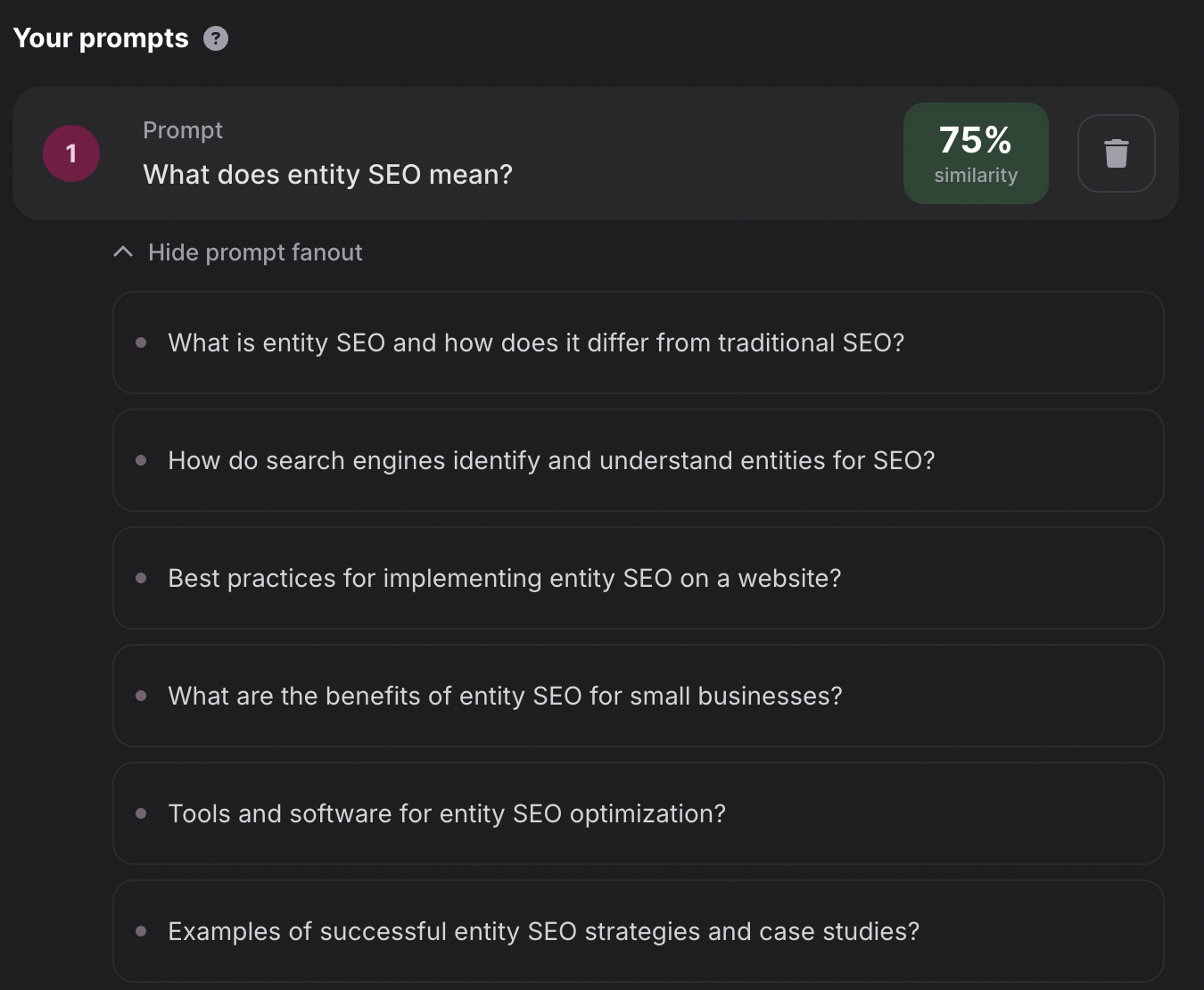
It then compares the prompts with the passages already identified on the page. The similarity score shows how closely a passage answers a particular question.
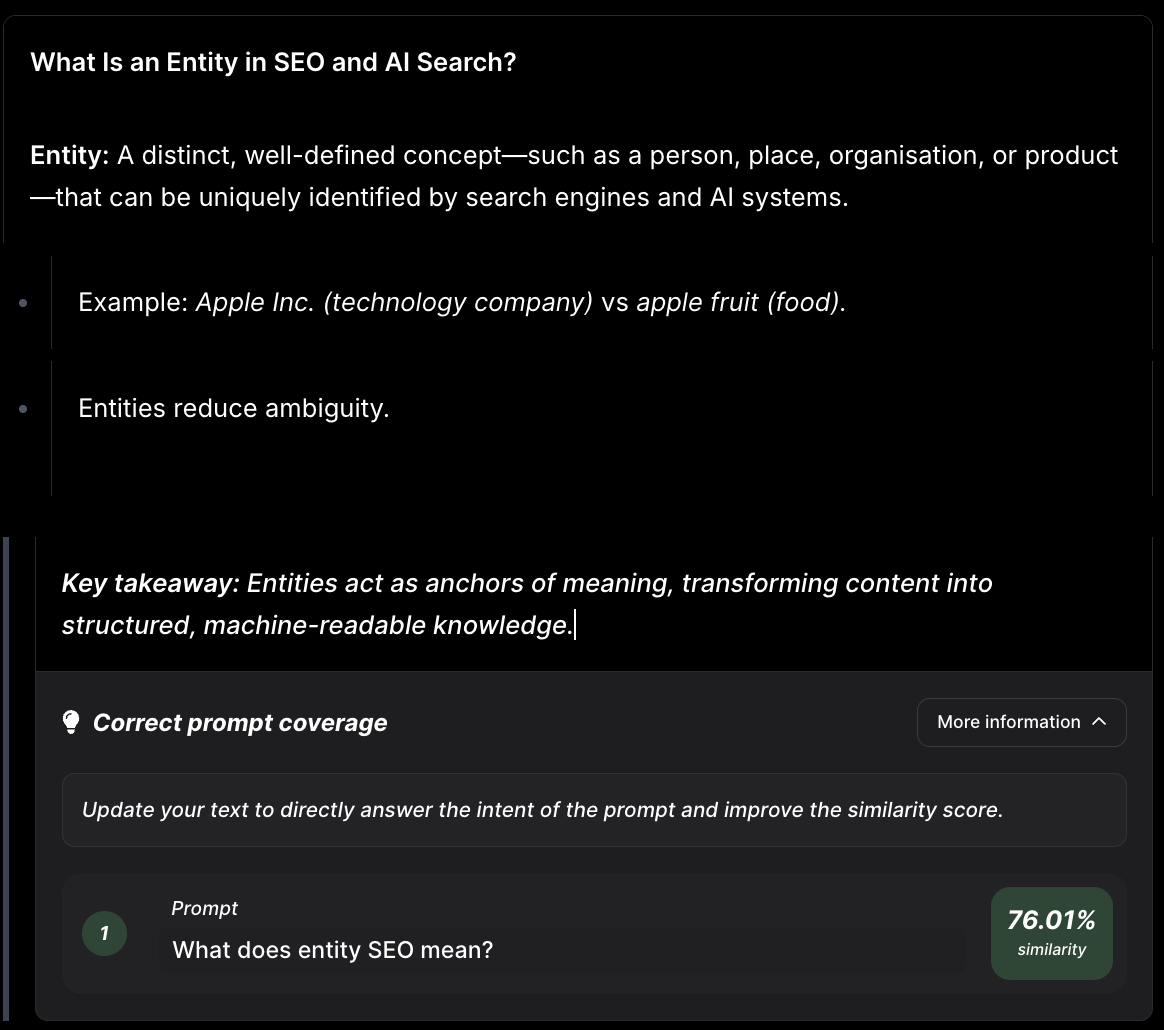
In the example above, the article contains a section about entities in SEO and AI search. When that passage is compared with the prompt "What does entity SEO mean?", it receives a similarity score of around 76%, which is a pretty good score. For lower scores, it might mean updating the section to answer the question more directly.
The platform can also identify missing entities, compare your coverage with competitors, and find internal linking opportunities between related pages. A broad article can therefore connect naturally to the product, pricing, support, or documentation page that contains the specific detail.
None of this guarantees that an AI engine will cite the page. But it gives you a clearer way to improve the parts of your content that retrieval systems are most likely to work with.
Frequently Asked Questions
How do AI systems choose which sources to cite?
The complete ranking logic is proprietary and varies by platform. There has been continuous effort to reverse-engineer how these systems work, including running prompts millions of times and tracking which sources keep showing up. But that's still insufficient because the models can be inconsistent with their answers, even across different runs and model releases. However, recent work by AI practitioners suggests that certain factors may "increase" your chances of appearing, including relevance to the generated search, freshness, specificity, authority, and how clearly the information is presented.
Do ChatGPT, Claude, Gemini, and Perplexity use the same fan-outs?
No, these systems are run by different companies: ChatGPT by OpenAI, Claude by Anthropic, and Gemini by Google. Their models are trained differently, and their retrieval systems work differently, even if they follow a broadly similar process when producing an answer. So they do not generate the same fan-outs; however, some platforms also expose more of the process than others.
What is the difference between source selection and citation?
When models want to provide an answer, they fan out and then collect sources where they get chunks of their information. That's source selection. After answers are provided, the models may choose to attach citations (usually as a link, footnote, or source marker) as a visible attribution. What you should know is that being used as a grounding source does not mean you'd show up in the synthesized answers.
Can a brand be mentioned without its website being cited?
Yes, being cited is not the same as being mentioned. The model may already know your brand from its training data, or it may find information about it through publishers, review platforms, retailers, competitors or other third-party sources. It does not need to cite your website for your brand to appear in the answer.
How can brands analyse query fan-outs?
Start with a fixed set of commercially relevant or high-intent prompts. You can either use a tool or manually record the fan-outs generated for each search, then pen down factors such as criteria added to each generated search, the brand mentioned, and the domains cited. Repeating these prompts over time and across relevant platforms allows you to build a more robust dataset.

Table of contents


Ready to build AI search optimisation into your stack?
Get in touch to find out more about our suite of content optimisation products built for AI Search.
.png)

Content Optimisation Built for AI search.